On-Page SEO Explained: The Elements That Actually Influence Rankings
Many websites look good.
They load fast.
They have a modern design.
They use a clean WordPress theme or a custom build.
They have nice images, good spacing, and a professional layout.
But they still do not rank.
This is one of the most common problems I see when working with business owners, digital agencies, and international clients. A website can be visually polished and technically functional, but still fail to bring organic traffic because the pages are not properly optimized for search engines, users, and search intent.
That is where on-page SEO becomes important.
I started working with SEO in 2008. Over the years, I have worked through freelancing platforms, directly with local and international clients, and as a white label SEO partner for agencies from markets such as the United States, Australia, and New Zealand.
One thing has remained true across different industries, countries, platforms, and business models:
A website does not rank just because it exists.
It ranks when search engines can understand it, users can trust it, and the content properly answers the search query.
On-page SEO is the part of SEO that helps make that happen.
What Is On-Page SEO?
Definition
On-page SEO is the process of optimizing individual pages on a website so they can rank better in search engines and provide a better experience for users.
It includes the visible content on the page, the HTML elements behind the page, the way keywords are used, the structure of the content, internal links, headings, images, metadata, and other page-level signals.
Longer Explanation
On-page SEO is about making a page clear, relevant, useful, and easy to understand.
It helps search engines understand what the page is about. It also helps users quickly understand whether they are in the right place.
A good on-page SEO process does not simply mean “adding keywords.” That is an outdated and limited view of SEO.
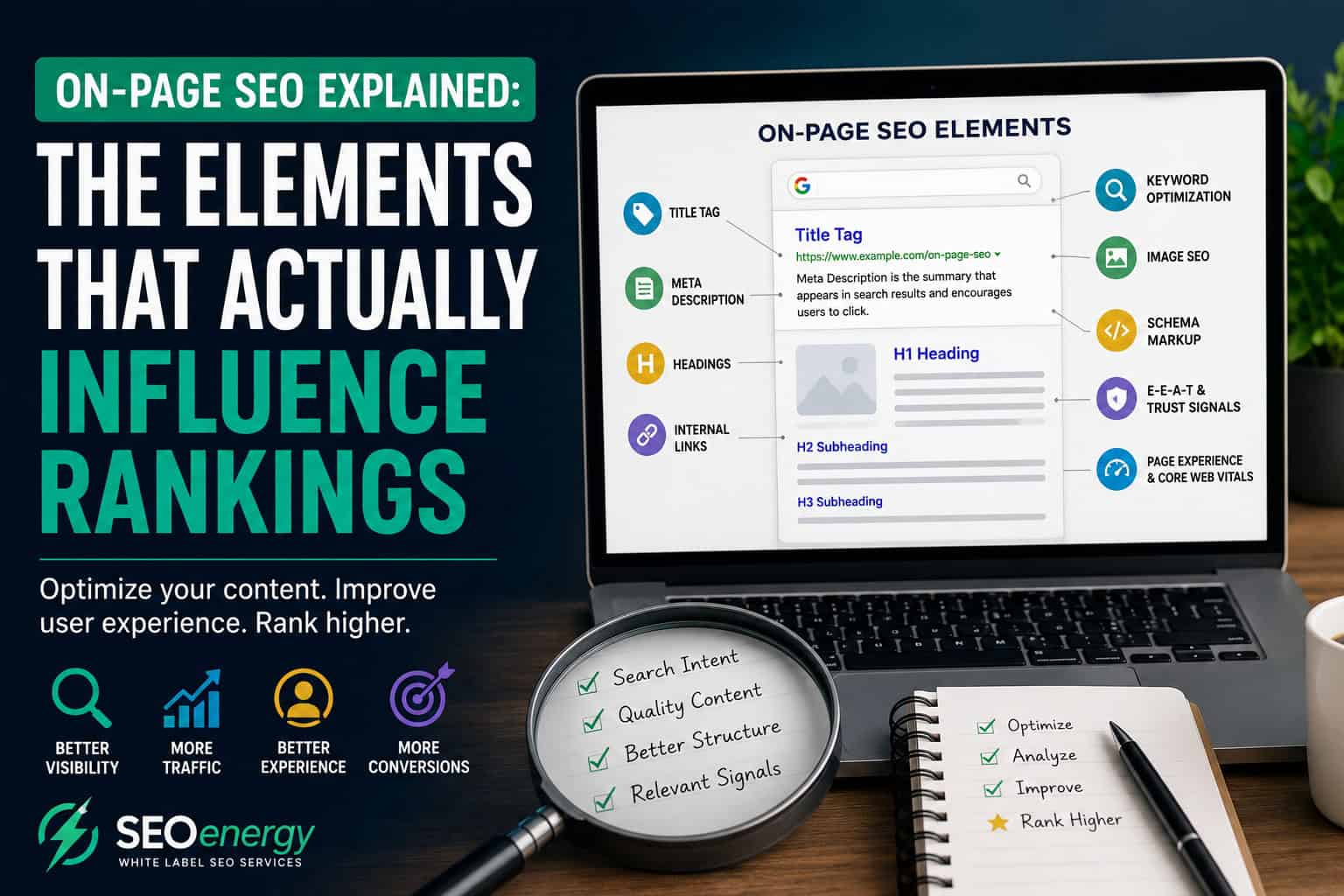
Modern on-page SEO includes:
- Matching the page to search intent
- Choosing the right primary keyword and supporting terms
- Writing a clear title tag
- Creating a useful meta description
- Using proper heading structure
- Improving content depth and clarity
- Adding internal links
- Optimizing images
- Improving page experience
- Adding schema markup where useful
- Making the page more trustworthy
- Helping the user take the next step
The goal is not to trick Google.
The goal is to create a page that deserves to rank because it is relevant, helpful, well-structured, and aligned with what the searcher wants.
Example
A service page for “local SEO services” should not only repeat the phrase “local SEO services” several times.
It should clearly explain:
- What local SEO is
- Who the service is for
- What is included
- What problems it solves
- What results a client can realistically expect
- Why the provider is credible
- How the process works
- What the next step is
That is on-page SEO done properly.
Common Misconceptions
A common misconception is that on-page SEO is only about keywords.
Keywords matter, but they are only one part of the process.
Another misconception is that on-page SEO is something you do once and then forget. In reality, important pages should be reviewed and improved over time as rankings, competitors, search behavior, and business priorities change.
Some people also believe that if a website looks professional, it must already be optimized. This is not always true. A page can look excellent to users but still be weak from an SEO perspective.
Why On-Page SEO Matters
On-page SEO matters because it directly affects how search engines understand your pages and how users respond once they land on them.
For business owners, it can mean more qualified traffic, more enquiries, and better use of the website they already paid for.
For agencies, it can improve client results, make SEO work easier to explain, and create a stronger foundation before investing in content, backlinks, or technical improvements.
Why Good Design and Fast Hosting Are Not Enough
A good-looking website is important. Fast hosting is important. Clean development is important.
But none of those things automatically mean the page is optimized for search.
A website can be visually impressive and still have:
- Weak title tags
- Missing or duplicated meta descriptions
- Poor heading structure
- Thin content
- No clear keyword focus
- No internal linking strategy
- Images with no useful alt text
- Service pages that do not answer important questions
- Blog posts that do not match search intent
- Pages that look good but say very little
Search engines need signals.
They need to understand what the page is about, how it relates to the rest of the website, whether it satisfies the user’s intent, and whether it is useful compared to other pages already ranking.
Users need signals too.
They need to know they are in the right place. They need clear information. They need trust. They need answers. They need a reason to stay, read, click, call, enquire, or buy.
This is why on-page SEO is not just a technical checklist. It is where SEO, content, UX, and conversion strategy overlap.
On-Page SEO vs Technical SEO vs Off-Page SEO
SEO is often divided into three main areas:
- On-page SEO
- Technical SEO
- Off-page SEO
They are connected, but they are not the same.
On-Page SEO
On-page SEO focuses on the content and optimization of individual pages.
This includes keywords, headings, title tags, internal links, images, content quality, search intent, and page structure.
Technical SEO
Technical SEO focuses on how well search engines can crawl, index, and access the website.
This includes site speed, mobile usability, indexation, redirects, canonical tags, structured data, XML sitemaps, robots.txt, Core Web Vitals, and technical errors.
Off-Page SEO
Off-page SEO focuses on signals outside the website, especially backlinks and brand mentions.
This includes link building, digital PR, citations, guest content, partnerships, and online reputation signals.
Example
Imagine a local dentist has a beautiful website.
If the website is slow, blocked from indexing, or full of crawl errors, that is a technical SEO problem.
If the service page does not explain dental implants properly, has a vague title tag, and does not mention the target location, that is an on-page SEO problem.
If no other relevant websites mention or link to the clinic, that is an off-page SEO problem.
The best SEO results usually come when all three areas work together.
Search Intent
Definition
Search intent is the reason behind a search query.
It explains what the user wants to find, learn, compare, buy, or do when they type something into Google.
Longer Explanation
Search intent is one of the most important parts of on-page SEO.
Before optimizing a page, you need to understand what kind of result the user expects.
The user may want:
- A definition
- A service provider
- A product
- A comparison
- A tutorial
- A local business
- A price estimate
- A checklist
- A review
- A solution to a specific problem
If your page does not match that intent, it may struggle to rank even if the content is well written.
For example, someone searching “what is on-page SEO” probably wants an educational explanation.
Someone searching “on-page SEO services” is more likely looking for a provider.
Someone searching “on-page SEO checklist” wants a practical list of actions.
Those keywords are related, but they should not always be handled in the same way.
Examples
For the keyword “technical SEO audit,” the user may be looking for a service.
For “technical SEO audit checklist,” the user likely wants a guide or checklist.
For “technical SEO audit cost,” the user is probably comparing prices.
For “hire technical SEO consultant,” the user is closer to making a commercial decision.
Common Misconceptions
One misconception is that every keyword should lead to a sales page.
That is not true.
Some keywords need educational content. Some need service pages. Some need comparison pages. Some need local landing pages. Some need product pages.
Another misconception is that search intent is always obvious. Sometimes you need to look at the actual search results to see what Google is already rewarding.
Why It Matters
Search intent matters because it determines the type of page you should create.
If the intent is wrong, the page can be beautifully written and still fail.
For business owners, this prevents wasting money on content that does not match what potential customers want.
For agencies, it helps explain why different keywords need different types of pages.
Keyword Research
Definition
Keyword research is the process of finding and analyzing the search terms people use when looking for information, products, or services.
Longer Explanation
Keyword research helps decide what each page should target.
It is not just about choosing the keyword with the highest search volume. It is about finding the best combination of relevance, intent, difficulty, competition, and business value.
A strong keyword strategy considers:
- What people search for
- How often they search for it
- How competitive the keyword is
- Whether the website can realistically rank
- Whether the keyword has commercial value
- What kind of page Google shows for that keyword
- How the keyword fits into the website structure
Keyword research should guide page creation, content updates, service page structure, blog planning, and internal linking.
Examples
A business coach may want to rank for “business coaching,” but that keyword is broad and competitive.
More specific opportunities may include:
- business coach for small business owners
- startup business coach
- business coaching for women entrepreneurs
- online business coaching program
- business growth consultant
Each keyword may need a slightly different page or section depending on intent.
Common Misconceptions
One misconception is that keyword research means finding as many keywords as possible.
That is not the goal.
The goal is to find the right keywords and understand how to use them.
Another misconception is that every page should target only one exact keyword. In reality, a well-optimized page can rank for many related terms if the topic is covered properly.
Why It Matters
Keyword research matters because it gives on-page SEO direction.
Without keyword research, pages are often written based on assumptions. With keyword research, content can be aligned with actual demand.
Title Tags
Definition
A title tag is an HTML element that defines the title of a web page for search engines and browser tabs.
It is often shown as the clickable headline in search results.
Longer Explanation
The title tag is one of the most important on-page SEO elements.
It helps search engines understand the main topic of the page. It also influences whether users click on your result.
A good title tag should be:
- Clear
- Relevant
- Specific
- Naturally keyword-focused
- Written for both search engines and humans
- Different from other title tags on the website
It should not be stuffed with keywords or written like a list of search terms.
Examples
Weak title tag:
SEO Services | SEO | SEO Agency | Best SEO | Google Ranking
Better title tag:
White Label SEO Services for Digital Agencies | SEOenergy
Weak title tag:
Home
Better title tag:
Local SEO Consultant for Small Businesses | SEOenergy
Common Misconceptions
A common misconception is that the title tag must include every keyword variation.
That usually makes the title look unnatural and spammy.
Another misconception is that Google will always show your exact title tag. Sometimes Google rewrites titles in search results, especially when the original title is unclear, too long, duplicated, or not aligned with the page.
Why It Matters
Title tags matter because they affect relevance and click-through rate.
For business owners, better title tags can improve how pages appear in search results.
For agencies, title tag optimization is often one of the quickest and most visible on-page SEO improvements.
Meta Descriptions
Definition
A meta description is a short HTML summary of a page that may appear under the title in search results.
Longer Explanation
Meta descriptions are not usually considered a direct ranking factor in the same way as content relevance or title tags.
However, they still matter.
A good meta description can improve click-through rate by helping users understand why they should visit your page.
It should summarize the page clearly and encourage the right kind of user to click.
A good meta description should:
- Explain what the page offers
- Include the main topic naturally
- Be specific
- Match search intent
- Avoid generic marketing language
- Give users a reason to click
Examples
Weak meta description:
Welcome to our website. We provide many services and help customers get great results.
Better meta description:
Learn what on-page SEO is, which elements influence rankings, and how SEOenergy helps businesses and agencies improve page-level SEO performance.
Common Misconceptions
One misconception is that meta descriptions directly push rankings higher.
They usually do not work that way.
Another misconception is that they do not matter at all. They can matter because a stronger search snippet can lead to more clicks from the same ranking position.
Why It Matters
Meta descriptions matter because search visibility is not only about ranking. It is also about getting the right people to click.
For agencies, meta descriptions are useful because they combine SEO, copywriting, and conversion thinking.
URLs
Definition
A URL is the web address of a page.
In on-page SEO, URL structure refers to how clear, readable, and relevant that address is.
Longer Explanation
A good URL helps users and search engines understand the page topic.
URLs should usually be short, descriptive, and easy to read.
They should avoid unnecessary numbers, dates, symbols, or random strings.
Examples
Weak URL:
example.com/page?id=8472
Better URL:
example.com/on-page-seo
Weak URL:
example.com/services/seo/seo-services-best-google-ranking-page
Better URL:
example.com/seo-services
Common Misconceptions
One misconception is that changing URLs always improves SEO.
It does not.
Changing URLs without proper redirects can damage rankings and traffic.
Another misconception is that URLs need to contain every keyword. A clean and simple URL is usually better.
Why It Matters
URLs matter because they help with clarity, usability, and structure.
For business owners, readable URLs look more professional.
For agencies, clean URL structure makes websites easier to manage and optimize.
Heading Structure
Definition
Heading structure refers to the way headings are organized on a page, usually using H1, H2, H3, and other heading tags.
Longer Explanation
Headings help structure content.
They make the page easier to scan for users and easier to understand for search engines.
The H1 is usually the main page heading. H2 headings divide the page into main sections. H3 headings support subsections.
Good heading structure should create a logical outline of the page.
It should not be used only for styling.
Examples
Good structure:
H1: On-Page SEO Explained
H2: What Is On-Page SEO?
H2: Why On-Page SEO Matters
H2: Core On-Page SEO Elements
H3: Title Tags
H3: Meta Descriptions
H3: Internal Links
H2: Common On-Page SEO Mistakes
Weak structure:
H1: Welcome
H3: Our Services
H2: Why Choose Us
H4: SEO
H2: More Information
Common Misconceptions
One misconception is that headings are just design elements.
They are not. They also communicate structure.
Another misconception is that adding keywords to every heading improves SEO. In reality, this can make the page feel repetitive and unnatural.
Why It Matters
Heading structure matters because users scan before they read.
If the page is easy to scan, users are more likely to stay. Search engines can also better understand the hierarchy of information.
Main Content
Definition
Main content is the primary body content of a page.
It is the part that answers the user’s query, explains the topic, presents the service, or provides the information the page was created for.
Longer Explanation
Main content is where many SEO campaigns succeed or fail.
A page with weak content may struggle even if the technical setup is good.
Strong content should be:
- Relevant
- Clear
- Helpful
- Specific
- Well-structured
- Original
- Trustworthy
- Aligned with search intent
- Useful for the target audience
It should answer real questions. It should explain the topic properly. It should guide the user toward the next step.
This does not always mean content must be extremely long. It means the content should be complete enough for the query.
Some pages need 600 words. Some need 2,000. Some need 5,000. The right length depends on the topic, intent, competition, and page purpose.
Examples
A weak service page says:
We provide professional SEO services. Contact us today for great results.
A stronger service page explains:
- What the service includes
- Who it is for
- What problems it solves
- How the process works
- What makes the provider credible
- What results are realistic
- What the client should expect
- What the next step is
Common Misconceptions
One misconception is that longer content always ranks better.
Longer content can help when the topic requires depth, but length alone is not quality.
Another misconception is that AI-generated content is automatically good enough. AI can help with drafts and structure, but content still needs strategy, accuracy, originality, and human judgment.
Why It Matters
Main content matters because it is the core of the page.
If the content does not satisfy the searcher, other optimizations may not be enough.
For business owners, content quality affects trust and conversions.
For agencies, content quality affects rankings, client satisfaction, and long-term SEO performance.
Keyword Placement
Definition
Keyword placement refers to where and how target keywords are used on a page.
Longer Explanation
Keywords should be used naturally in important areas of the page.
This may include:
- Title tag
- H1 heading
- First paragraph
- Some H2 headings where relevant
- Body content
- Image alt text where appropriate
- URL
- Internal link anchor text
- Meta description
The goal is not to repeat the same phrase as many times as possible.
The goal is to make the topic clear.
Modern SEO also looks at related terms, entities, context, and overall topical relevance. That means a strong page should cover the subject naturally, not just repeat one exact keyword.
Examples
If the target keyword is “on-page SEO,” related terms might include:
- title tags
- meta descriptions
- internal links
- search intent
- heading structure
- content optimization
- image SEO
- schema markup
- page experience
Using these terms naturally helps create a more complete page.
Common Misconceptions
The biggest misconception is that keyword density still matters in a mechanical way.
For example, “use the keyword exactly 2-3 times per 500 words” is too simplistic.
There is no universal keyword density that guarantees rankings.
Another misconception is that exact-match keywords must be forced into awkward sentences. This often makes content worse.
Why It Matters
Keyword placement matters because it helps search engines understand the page topic.
But it must be natural. Poor keyword use can make a page look spammy and reduce trust.
Internal Linking
Definition
Internal linking means linking from one page on your website to another page on the same website.
Longer Explanation
Internal links help users and search engines move through the website.
They also help distribute authority between pages and show relationships between topics.
For example, a blog post about keyword research might link to a service page for SEO strategy. A local SEO guide might link to a Google Business Profile optimization page.
Good internal linking helps answer questions such as:
- Which pages are most important?
- Which topics are related?
- Where should users go next?
- Which service page should this blog post support?
Internal links are especially useful because they are fully under your control.
Examples
A blog post about “What Is On-Page SEO?” could internally link to:
- On-page SEO services
- Technical SEO audit
- Keyword research guide
- SEO content writing
- White label SEO services
A local dentist’s blog post about “How long do dental implants last?” could link to the main dental implants service page.
Common Misconceptions
One misconception is that internal links are only for navigation menus.
They are not. Contextual links inside content are often very useful.
Another misconception is that every page should link to every other page. That creates clutter and weakens relevance.
Why It Matters
Internal linking matters because it improves crawlability, user experience, and topical structure.
For agencies, internal linking is one of the most practical ways to improve existing websites without creating new content immediately.
Image SEO
Definition
Image SEO is the process of optimizing images so they support page performance, accessibility, and search visibility.
Longer Explanation
Images can improve user experience, but they can also slow down a website if handled poorly.
Image SEO includes:
- Compressing images
- Using appropriate file formats
- Writing useful alt text
- Naming files clearly
- Using responsive image sizes
- Avoiding huge image files
- Making sure images support the content
Alt text is especially important for accessibility and context. It helps screen readers and can help search engines understand the image.
However, alt text should not be stuffed with keywords.
Examples
Weak file name:
IMG_4829.jpg
Better file name:
on-page-seo-audit-example.jpg
Weak alt text:
SEO SEO services best SEO ranking
Better alt text:
Screenshot of an on-page SEO audit showing title tags, headings, and meta descriptions.
Common Misconceptions
One misconception is that every image alt text should contain the main keyword.
That is not necessary and can become spammy.
Another misconception is that image SEO is only about Google Images. In reality, image optimization also affects loading speed, accessibility, and page quality.
Why It Matters
Image SEO matters because images affect both performance and usability.
For business owners, optimized images can make a website faster and more professional.
For agencies, image SEO is often a simple improvement that can be included in broader on-page work.
Schema Markup
Definition
Schema markup is structured data added to a page to help search engines better understand the content.
Longer Explanation
Schema does not replace good content, but it can give search engines clearer information about a page.
There are different types of schema, including:
- Organization schema
- Local business schema
- FAQ schema
- Article schema
- Product schema
- Review schema
- Service schema
- Breadcrumb schema
Schema can sometimes help pages appear with richer search results, depending on the query and Google’s display choices.
For local businesses, schema can help reinforce business information such as name, address, phone number, opening hours, service area, and business type.
Examples
A local dental clinic may use LocalBusiness or Dentist schema.
A blog article may use Article schema.
A service page may use Service schema.
An FAQ section may use FAQ schema where appropriate.
Common Misconceptions
One misconception is that schema automatically improves rankings.
It does not work like that.
Schema helps search engines understand content more clearly, but it is not a magic ranking shortcut.
Another misconception is that adding as much schema as possible is always better. Schema should be accurate and relevant to the page.
Why It Matters
Schema matters because it improves clarity for search engines.
For agencies, it is a useful part of a more complete SEO implementation, especially for local businesses, service businesses, publishers, and e-commerce websites.
E-E-A-T Signals
Definition
E-E-A-T stands for Experience, Expertise, Authoritativeness, and Trustworthiness.
It describes the qualities Google wants to see in high-quality content, especially for topics where accuracy and trust matter.
Longer Explanation
E-E-A-T is not a single score you can see in an SEO tool.
It is a concept used to evaluate content quality and credibility.
A page can demonstrate E-E-A-T through:
- Real experience
- Clear author information
- Accurate content
- Transparent business details
- Case studies
- Reviews
- Testimonials
- Credentials
- Useful examples
- External mentions
- Strong brand reputation
- Clear contact information
- Updated content
For many businesses, trust is not only an SEO issue. It is also a conversion issue.
Users want to know who is behind the website, why they should believe the content, and whether the business is legitimate.
Examples
A medical article written or reviewed by a qualified professional has stronger trust signals than an anonymous article.
An SEO service page with real process details, examples, case studies, and transparent explanations is more trustworthy than a generic page promising “top rankings fast.”
A local business with real reviews, consistent contact details, photos, and a complete About page is more credible than a thin website with no visible identity.
Common Misconceptions
One misconception is that E-E-A-T is only for medical or financial websites.
It is especially important for those industries, but trust matters in almost every niche.
Another misconception is that adding an author box automatically solves everything. Author information helps, but the content itself still needs to be useful and credible.
Why It Matters
E-E-A-T matters because search engines and users both need trust.
For business owners, stronger trust signals can increase enquiries and conversions.
For agencies, E-E-A-T helps improve content quality and makes websites feel more legitimate.
Page Experience and Core Web Vitals
Definition
Page experience refers to how users experience a web page, especially in terms of speed, usability, stability, and mobile friendliness.
Core Web Vitals are a set of performance metrics that help measure parts of that experience.
Longer Explanation
A page should not only contain good content. It should also be pleasant and easy to use.
Page experience includes:
- Loading speed
- Mobile usability
- Visual stability
- Responsiveness
- Clear layout
- Readable fonts
- Non-intrusive popups
- Easy navigation
- Secure browsing
- Good user flow
Core Web Vitals are technical performance metrics, but they connect directly to user experience.
If a page loads slowly, shifts around while loading, or responds poorly to interaction, users may leave.
Examples
Poor page experience:
- A page takes 8 seconds to load
- Text jumps while images load
- Buttons are hard to tap on mobile
- Popups cover the content
- Fonts are too small
- The main content is pushed too far down the page
Better page experience:
- The page loads quickly
- Content is readable
- Layout is stable
- Calls to action are clear
- Mobile users can navigate easily
- Images are optimized
Common Misconceptions
One misconception is that speed alone is enough for SEO.
Speed is important, but a fast page with weak content may still not rank.
Another misconception is that design and SEO are separate. In reality, design affects readability, engagement, trust, and conversions.
Why It Matters
Page experience matters because users make fast decisions.
For business owners, better page experience can improve leads and sales.
For agencies, it connects web design, development, SEO, and conversion optimization into one stronger service.
Pre-Click SEO
Definition
Pre-click SEO includes the elements users see before they click on your website in search results.
Longer Explanation
Pre-click SEO influences whether a user chooses your result over another result.
The main elements include:
- Title tag
- Meta description
- URL
- Rich results
- Review stars where eligible
- Brand name
- Search result appearance
Ranking is important, but ranking alone is not enough.
If your search result looks vague, boring, or irrelevant, users may choose a competitor instead.
Example
Weak search result:
SEO Services
We provide services for your business. Contact us today.
Stronger search result:
On-Page SEO Services for Businesses and Agencies | SEOenergy
Improve title tags, content structure, internal links, metadata, and page-level SEO with practical on-page optimization.
Common Misconceptions
One misconception is that only rankings matter.
Click-through rate also matters because visibility without clicks does not bring business results.
Another misconception is that meta descriptions are unimportant because they are not direct ranking factors. They can still influence user behavior.
Why It Matters
Pre-click SEO matters because it affects how many people choose your website from the search results.
For business owners, this can mean more traffic from existing rankings.
For agencies, it is an easy way to show visible improvements in how a client appears in Google.
Post-Click SEO
Definition
Post-click SEO includes everything users experience after they click on your result and land on your page.
Longer Explanation
Post-click SEO focuses on what happens after the visitor arrives.
It includes:
- Main heading
- Introductory content
- Page structure
- Body copy
- Internal links
- Images
- Calls to action
- Trust signals
- Page speed
- Mobile experience
- Content quality
- Conversion path
The goal is to satisfy the user’s search intent and guide them toward the next step.
That next step may be reading another article, requesting a quote, booking a call, filling out a form, calling the business, downloading a guide, or buying a product.
Example
If someone searches for “white label SEO services,” lands on your page, and still cannot understand what is included, who the service is for, or how to start, the page has a post-click SEO problem.
If the page clearly explains the offer, shows trust signals, answers common questions, and provides a clear CTA, the experience is much stronger.
Common Misconceptions
One misconception is that SEO ends when the user clicks.
It does not.
If users quickly leave because the page does not help them, that is a problem.
Another misconception is that conversion optimization is separate from SEO. In practice, the two often overlap.
Why It Matters
Post-click SEO matters because traffic alone does not pay the bills.
For business owners, post-click SEO helps turn visitors into leads or customers.
For agencies, it helps connect SEO performance with business outcomes.
Common On-Page SEO Mistakes
Many websites do not have one huge SEO problem. They have many smaller problems that add up.
Here are some of the most common on-page SEO mistakes.
1. Keyword Stuffing
Keyword stuffing means forcing the same keyword into the page too many times.
This makes content sound unnatural and can reduce trust.
Better approach:
Use the main keyword naturally and support it with related terms, examples, and useful explanations.
2. Ignoring Search Intent
A page may target a keyword but fail to answer what the searcher actually wants.
Better approach:
Check the search results, understand the user’s goal, and create the right type of page.
3. Thin Content
Thin content does not explain enough, answer enough, or provide enough value.
Better approach:
Add useful details, examples, FAQs, comparisons, process explanations, and trust signals.
4. Weak Title Tags
Generic title tags make it harder for users and search engines to understand the page.
Better approach:
Write clear, specific, keyword-relevant titles.
5. Duplicate Meta Data
Many websites have repeated or missing title tags and meta descriptions.
Better approach:
Create unique metadata for important pages.
6. Poor Internal Linking
Important pages are often buried or not linked from relevant content.
Better approach:
Use contextual internal links to connect related pages.
7. Bad Heading Structure
Headings are sometimes used only for design, not structure.
Better approach:
Use headings to create a logical outline.
8. No Clear CTA
Some pages bring traffic but do not guide the visitor anywhere.
Better approach:
Add clear next steps, such as booking a call, requesting a quote, reading a related page, or contacting the business.
9. Over-Relying on Design
A beautiful page with weak content may still underperform.
Better approach:
Combine good design with clear messaging, search intent, and proper optimization.
10. Publishing Without Updating
SEO content can become outdated.
Better approach:
Review important pages regularly and improve them based on performance, competitors, and new business goals.
Where Link Building Fits Into On-Page SEO
Link building is not technically on-page SEO. It belongs to off-page SEO.
However, it is closely connected.
Backlinks can help build authority, but they work best when the pages receiving those links are properly optimized.
If a page has weak content, poor structure, unclear intent, or bad internal links, backlinks may not produce the expected results.
In simple terms:
On-page SEO helps make the page worth ranking.
Link building helps increase the authority and trust signals needed to compete.
Both are important.
Example
A local service page may have strong backlinks pointing to it, but if the page does not clearly explain the service, location, process, pricing factors, FAQs, and trust signals, users may not convert.
On the other hand, a well-optimized page with no authority may still struggle in a competitive niche.
The strongest campaigns usually combine both.
Why On-Page SEO Matters for Business Owners
For business owners, on-page SEO matters because it helps your website work harder.
You may already have a website. You may already be paying for hosting, design, content, ads, or maintenance.
But if your pages are not optimized, you may be missing organic traffic that should be possible.
Good on-page SEO can help:
- Improve search visibility
- Make pages clearer
- Attract more relevant visitors
- Improve trust
- Increase enquiries
- Support paid campaigns
- Improve conversion rates
- Make your website easier to understand
- Reduce wasted content effort
It also gives your website a stronger foundation.
Before investing heavily in backlinks, new blog content, or advanced SEO campaigns, it often makes sense to improve the important pages already on the site.
Why On-Page SEO Matters for Agencies
For agencies, on-page SEO matters because it improves delivery quality.
If you build websites for clients, run ads, create content, or manage marketing, on-page SEO can make your work more valuable.
A client’s website may look good, but if the pages are not structured for search and conversion, the client may not get the results they expected.
On-page SEO helps agencies:
- Improve client websites after launch
- Add SEO value to web design projects
- Create stronger landing pages
- Support content marketing
- Improve client retention
- Build recurring revenue
- Offer more complete marketing services
- Deliver better white label SEO outcomes
For agencies that do not want to build an in-house SEO team, working with a white label SEO partner can make this easier.
What Is White Label On-Page SEO?
Definition
White label on-page SEO is when an external SEO provider performs on-page SEO work for an agency’s clients under the agency’s brand.
Longer Explanation
This allows agencies to offer SEO services without hiring an internal SEO team.
The agency keeps the client relationship. The white label provider handles the SEO work behind the scenes.
This can include:
- Page audits
- Keyword mapping
- Title tag optimization
- Meta description writing
- Heading structure improvements
- Content briefs
- Content optimization
- Internal linking recommendations
- Image SEO
- Schema recommendations
- On-page SEO reporting
Example
A web design agency builds a new website for a client.
The client also wants SEO.
Instead of hiring an SEO employee, the agency works with SEOenergy to optimize the client’s key pages. The agency presents the work under its own brand, while SEOenergy supports the SEO strategy and implementation.
Common Misconceptions
One misconception is that white label SEO means low-quality outsourcing.
It should not.
A good white label SEO partner should provide reliable, strategic, and professional work that strengthens the agency’s offer.
Another misconception is that agencies must reveal every backend partnership to clients. That depends on the agency’s business model and client relationship.
Why It Matters
White label on-page SEO matters because many agencies want to offer SEO, but do not want the cost and complexity of building a full SEO department.
It allows agencies to serve clients better while staying focused on their core services.
How SEOenergy Helps With On-Page SEO
SEOenergy helps business owners and digital agencies improve on-page SEO in a practical, structured way.
The goal is not to create generic SEO checklists.
The goal is to look at the website, understand the page purpose, review the search opportunity, and improve the elements that actually affect performance.
This can include:
- Reviewing existing pages
- Identifying weak on-page elements
- Improving title tags and meta descriptions
- Restructuring headings
- Improving keyword targeting
- Matching pages to search intent
- Strengthening service page content
- Improving internal links
- Optimizing images
- Adding or recommending schema markup
- Improving trust signals
- Creating content briefs for new pages
- Supporting agencies with white label SEO delivery
For business owners, this means clearer pages, stronger search visibility, and a website that is more aligned with how potential customers search.
For agencies, it means a reliable SEO partner who can help improve client websites without requiring an internal SEO department.
Final Thoughts
On-page SEO is not just about keywords.
It is about making each page clearer, stronger, more useful, and more aligned with what users and search engines need.
A good page should answer the right query, use the right structure, explain the topic properly, guide the user, and support the business goal.
That is why on-page SEO is one of the most important foundations of any SEO campaign.
Before asking why a website does not rank, it is worth asking:
Is the page actually optimized?
Does it match search intent?
Is the content strong enough?
Are the title, headings, internal links, and metadata clear?
Does the page give users a reason to trust the business?
Does it help them take the next step?
If the answer is no, on-page SEO is usually one of the best places to start.
SEOenergy helps businesses and agencies improve these foundations so websites are not only better designed, but also better structured for search, users, and real business results.