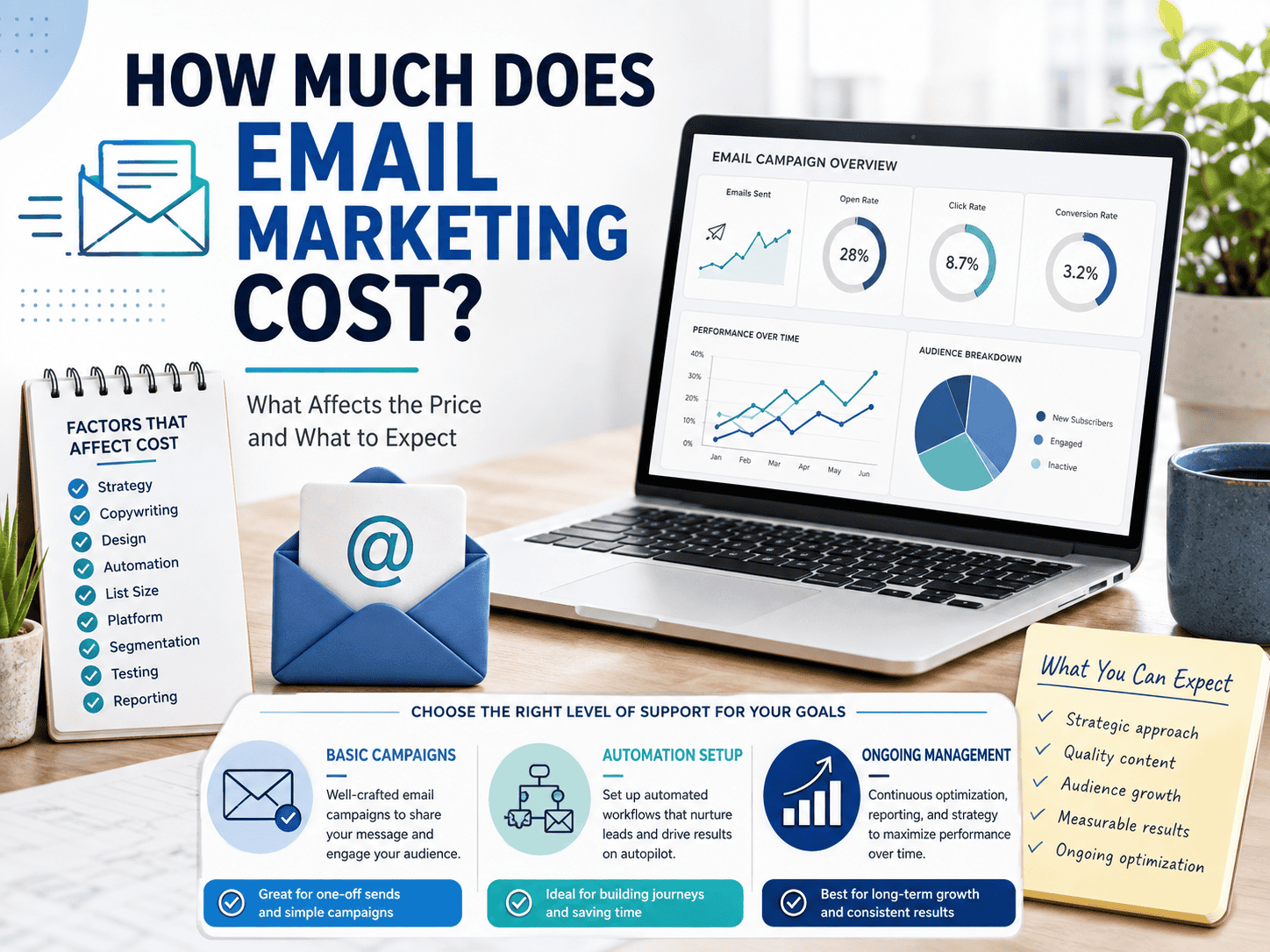
How Much Does Email Marketing Cost?
Same honest answer as before: it depends. Email marketing runs from a one-time setup to a continuous monthly service, and the two aren’t priced anything alike. Someone who wants a single welcome sequence and someone who wants a fully managed list are both asking about “email marketing,” but they’re buying very different things.
The work splits into one-off pieces (setup, design, writing a sequence) and ongoing work (sending, managing, improving). The price notes below say which is which. Here’s the breakdown:
- Setup & strategy (platform, strategy, list import)
- List building (signup forms, lead magnets, segmentation)
- Design (emails, forms, lead magnets, pages)
- Copy & content (newsletters, sales emails, pages, system messages)
- Automations (welcome, sequences, behavioral flows)
- Ongoing & reporting (campaigns, deliverability, optimization)
As with the other guides, each item notes how common it is, since almost no one needs all of it. Rough price ranges come at the end.
Setup & strategy
This is the groundwork that everything else runs on: the platform, the plan, and a clean starting list. Get it right and the rest goes smoothly; skip it and problems tend to surface later, usually at the worst time.
Platform setup
Platform setup is getting the email tool ready to work: account configuration, sender authentication, and the basic settings that keep emails landing where they should.
This usually includes
- setting up the account and sender details
- authentication so emails are trusted (SPF, DKIM, DMARC)
- connecting the site, forms, and any other tools
How common it is
Essential, and done once. Everything after it depends on this being right.
Client input
The client provides access to their domain and existing tools. Sorting out domain and DNS access is usually the only real back-and-forth here.
Price impact
A clean setup on a common platform is quick. Migrating from another tool, or untangling a messy existing account, takes longer.
Price range
Roughly EUR 100 to 500 as a one-off, depending on the platform and how much needs connecting. Most projects land in this range, but the final figure is set case by case, since too many inputs feed into it to fix one price.
Email strategy
Email strategy is the plan behind the sending: who’s on the list, what they should receive, how often, and what it’s all meant to achieve.
This can include
- defining goals and the type of emails to send
- planning frequency and the overall calendar
- deciding how list, content, and offers fit together
How common it is
Recommended for anyone treating email as a real channel rather than the occasional blast. A light version suits small lists; bigger operations benefit from a fuller plan.
Client input
The client’s goals, offers, and knowledge of their audience shape the whole plan, so it works best as a conversation rather than a handover.
Price impact
A simple plan for a small list is quick. A full strategy across segments, offers, and a content calendar takes more upfront work, but keeps everything after it focused.
Price range
Roughly EUR 150 to 1,000 as a one-off, depending on how much is already decided. Most projects land in this range, but the final figure is set case by case, since too many inputs feed into it to fix one price.
List import & cleanup
List import and cleanup is bringing an existing list of contacts into the platform and making sure it’s healthy before anything is sent to it.
This can involve
- importing and organizing existing contacts
- removing invalid, duplicate, or inactive addresses
- checking the list was collected with proper consent
How common it is
Relevant for anyone with an existing list. Sending to a messy or unverified list is one of the fastest ways to land in spam.
Client input
The client provides the existing list and how it was gathered. Where it came from matters as much as the addresses themselves, since consent affects whether it’s safe to use.
Price impact
A clean, well-kept list imports quickly. An old or messy one needs verification and pruning first, which takes more time but protects everything sent afterward.
Price range
Roughly EUR 80 to 400 as a one-off, depending on list size and condition. Most projects land in this range, but the final figure is set case by case, since too many inputs feed into it to fix one price.
List building
List building is how the audience grows and how it’s organized once people are on it. A big list of the wrong people is worth less than a small list of the right ones, so this is as much about structure as it is about numbers.
Signup forms & lead magnets
Signup forms and lead magnets are how visitors get onto the list: the forms they fill in, and the incentive that makes it worth doing.
This can include
- signup forms (popup, embedded, inline)
- a lead magnet as the incentive to subscribe
- connecting forms to the right list and tags
How common it is
Recommended for anyone actively growing a list. Without a reason to subscribe and an easy way to do it, a list grows slowly.
Client input
The client’s offer and audience shape what makes a compelling incentive. Knowing what their audience actually wants is what makes a lead magnet work.
Price impact
A simple form is quick. A lead magnet plus the forms and connections around it is a larger piece, though design of the magnet itself is a separate line.
Price range
Roughly EUR 100 to 600 as a one-off for the setup, with lead magnet design priced separately. Most projects land in this range, but the final figure is set case by case, since too many inputs feed into it to fix one price.
Segmentation & tagging setup
Segmentation and tagging setup is the system that labels subscribers automatically, by where they signed up, what they’re interested in, or how they behave, so you can send the right thing to the right people.
This usually involves
- tagging by signup source and interest
- rules that label subscribers as they act
- groups and segments for targeted sending
How common it is
Recommended once a list serves more than one purpose. A single small list may not need it; anything with different audiences or offers does.
Client input
The client’s sense of how their audience divides up (by service, interest, or stage) guides which tags and segments are worth setting up.
Price impact
A couple of simple tags are quick. A full tagging system tied to multiple forms, offers, and behaviors takes real planning to set up cleanly.
Price range
Roughly EUR 100 to 700 as a one-off, depending on how detailed the system is. Most projects land in this range, but the final figure is set case by case, since too many inputs feed into it to fix one price.
Design
Design here covers everything the subscriber actually sees, from the emails themselves to the forms, downloads, and pages around them. Consistent, clean design is a big part of whether the whole thing looks trustworthy or slapped together.
Email HTML design
Email HTML design is designing and coding the email template so it looks right and works across the many email clients people actually use.
Scope and price depend on
- how custom the design is versus a standard template
- reliable rendering across clients (Outlook, Gmail, and the rest)
- reusable sections for future emails
How common it is
Recommended for anyone sending regularly. Email clients are notoriously inconsistent, so a template that holds up everywhere is worth having.
Client input
The client’s branding guides the look. Applying an existing brand is simple; without one, some basics have to be settled first.
Price impact
A clean, on-brand template is a defined job. Cross-client testing is what quietly adds the time, since email rendering is far less forgiving than the web.
Price range
Roughly EUR 150 to 800 as a one-off for a reusable template. Most projects land in this range, but the final figure is set case by case, since too many inputs feed into it to fix one price.
Signup form design
Signup form design is the look and feel of the forms people use to subscribe, so they fit the brand and actually invite signups rather than getting ignored.
This can include
- styling popup, embedded, and inline forms
- matching them to the brand and the page around them
- keeping them clear and easy to complete
How common it is
Recommended alongside any signup forms. A form that looks out of place or clumsy costs signups quietly.
Price impact
Light styling on a platform’s built-in forms is quick. Fully custom, on-brand forms across several placements take more work.
Price range
Roughly EUR 60 to 350 as a one-off, depending on how many forms and how custom. Most projects land in this range, but the final figure is set case by case, since too many inputs feed into it to fix one price.
Lead magnet design
Lead magnet design is turning the incentive (a guide, checklist, or similar) into a polished, on-brand file people are glad they downloaded.
This usually covers
- designing PDFs, slide decks, or similar formats
- layout, branding, and readability
- preparing the final file for delivery
How common it is
Relevant whenever a lead magnet is offered. The content can be great, but a rough-looking file undercuts the first impression.
Client input
The client provides the content or raw material. The work is shaping it into something clean and branded, not writing it from scratch.
Price impact
A simple one-pager is quick. A longer, heavily designed guide or deck takes considerably more time.
Price range
Roughly EUR 100 to 600 as a one-off, depending on length and design detail. Most projects land in this range, but the final figure is set case by case, since too many inputs feed into it to fix one price.
Landing & capture page design
Landing and capture page design is the design of the pages email links point to: capture pages to subscribe, sales pages, and thank-you pages.
This can include
- capture pages built around a single signup
- sales pages that continue the email’s message
- thank-you and confirmation pages
How common it is
Recommended when email drives people to dedicated pages rather than the general site. Common for lead magnets, launches, and webinars.
Price impact
A single focused capture page is a defined job. A full set of matching pages for a launch or funnel is a larger one. This is design only; the copy for these pages is a separate line.
Price range
Roughly EUR 150 to 900 as a one-off, depending on how many pages and how custom. Most projects land in this range, but the final figure is set case by case, since too many inputs feed into it to fix one price.
System page design
System page design is styling the built-in pages the platform shows subscribers: unsubscribe, double opt-in confirmation, and preference or subscription-settings pages.
This usually covers
- unsubscribe and preference pages
- double opt-in confirmation pages
- matching these to the brand rather than platform defaults
How common it is
Optional, and often skipped. Worth doing for a polished, consistent feel, since these default pages are usually plain and off-brand.
Price impact
Light branding of default pages is quick and cheap. It’s a small touch, but it keeps even the routine moments looking like the same brand.
Price range
Roughly EUR 40 to 250 as a one-off, often bundled with email design. Most projects land in this range, but the final figure is set case by case, since too many inputs feed into it to fix one price.
Copy & content
This is the writing: the actual words in the emails and on the pages they lead to. It’s where a campaign is won or lost, since design gets an email opened but the writing is what makes anything happen after that.
Newsletter copy
Newsletter copy is the writing for regular, ongoing emails that inform, share, or keep an audience engaged rather than sell directly.
Scope and price depend on
- length and depth of each issue
- how much research or original thinking it needs
- how much the client supplies versus writing from scratch
How common it is
Recommended for anyone sending regularly. A consistent newsletter is one of the main ways a list stays warm.
Client input
Topics, notes, or a rough draft from the client speed things up. The more direction they give, the closer it lands to their voice.
Price impact
A short, simple issue is quick. A longer, well-researched one written from scratch takes more time per send.
Price range
Roughly EUR 50 to 250 per issue, depending on length and how much is supplied. Most projects land in this range, but the final figure is set case by case, since too many inputs feed into it to fix one price.
Sales email copy
Sales email copy is persuasive writing that continues from where a subscriber signed up, warming them toward an offer rather than just informing.
This can include
- emails that follow on from a capture or sales page
- warming subscribers toward an offer over several sends
- clear calls to action tied to the goal
How common it is
Recommended for anyone selling through email. This is the writing that turns a list into actual results.
Client input
The offer, audience, and objections shape the writing, so a short briefing upfront makes the copy far sharper. Like sales copy generally, it usually goes through drafts and revisions rather than landing in one pass.
Price impact
A single sales email is a defined job. A full sequence written to build toward an offer is a larger one, since each email has to move the reader along.
Price range
Roughly EUR 60 to 300 per email, less per email across a longer sequence. Most projects land in this range, but the final figure is set case by case, since too many inputs feed into it to fix one price.
Page copy
Page copy is the writing for the pages email points to: capture pages, sales pages, and thank-you pages. It’s the words on those pages, separate from their design.
This can include
- capture page copy that earns the signup
- sales page copy that continues the email’s message
- thank-you and confirmation page wording
How common it is
Recommended when email drives people to dedicated pages. The page has to carry on the promise the email made.
Client input
The offer and audience shape this, and it works best written together with the emails that lead to it, so the message stays consistent from inbox to page.
Price impact
A short capture page is quick. A full sales page carries research and revisions behind it, much like sales copy anywhere, and is priced accordingly.
Price range
Roughly EUR 80 to 800 per page, depending on type and depth. Most projects land in this range, but the final figure is set case by case, since too many inputs feed into it to fix one price.
System & transactional copy
System and transactional copy is the wording of the automatic, functional messages: double opt-in confirmations, receipts, and notifications.
This usually covers
- double opt-in and confirmation wording
- receipts, notifications, and system messages
- keeping these on-brand rather than robotic
How common it is
Optional, and easy to overlook. These messages are opened surprisingly often, so plain defaults are a small missed opportunity.
Price impact
This is light work: a few short messages. Small effort, but it keeps even the automatic moments sounding like the brand rather than the software.
Price range
Roughly EUR 30 to 150 as a one-off, often bundled with a wider job. Most projects land in this range, but the final figure is set case by case, since too many inputs feed into it to fix one price.
Automations
Automations are the sequences that send themselves once set up, triggered by a signup or an action. They’re where email quietly does its best work: the same flow, built once, keeps working for every new subscriber without further effort.
Welcome flow
A welcome flow is the first message or short series someone gets right after subscribing, setting the tone and pointing them somewhere useful.
This usually includes
- one or more emails triggered on signup
- an introduction and what to expect
- a first step, offer, or useful link
How common it is
Recommended for almost any list. The moment after someone subscribes is when they’re most engaged, and easy to waste.
Client input
The client’s goal for new subscribers shapes it: what the first impression should be and where to send people next.
Price impact
A single welcome email is quick. A short welcome series with a clear arc takes more writing and setup, but earns its keep on every new signup.
Price range
Roughly EUR 100 to 500 as a one-off for the flow, copy included or priced with it. Most projects land in this range, but the final figure is set case by case, since too many inputs feed into it to fix one price.
Educational sequence
An educational sequence is a series that delivers content in parts over several emails, teaching or guiding the subscriber toward a goal.
This can include
- a multi-part series on one theme
- content delivered in a planned order over days or weeks
- a soft path toward a related offer at the end
How common it is
Recommended for lists built around a specific topic or lead magnet. A good example is a themed series, such as steps to take before a website redesign, delivered over several parts.
Client input
The client’s expertise and material feed the content. The more they can supply, the richer and more credible the sequence.
Price impact
A short sequence is a defined job. A longer, well-researched series is a larger one, since each part has to stand on its own and lead into the next.
Price range
Roughly EUR 250 to 1,200 as a one-off, depending on length and how much is written from scratch. Most projects land in this range, but the final figure is set case by case, since too many inputs feed into it to fix one price.
Sales build-up sequence
A sales build-up sequence is a series that warms a subscriber toward a specific offer, such as a webinar they registered for or a lead magnet they downloaded.
This usually involves
- a planned series leading to one offer or event
- building interest and handling objections along the way
- a clear push at the right moment
How common it is
Recommended for anyone selling a specific product, service, or event through email. This is where sequences most directly turn into revenue.
Client input
The offer, audience, and their likely objections shape the whole sequence, so a briefing upfront matters. Like other sales writing, it goes through drafts rather than one pass.
Price impact
A few emails toward a simple offer is a defined job. A longer launch or webinar sequence with careful timing is a larger, higher-value one.
Price range
Roughly EUR 300 to 1,500 as a one-off, depending on length and the stakes of the offer. Most projects land in this range, but the final figure is set case by case, since too many inputs feed into it to fix one price.
Behavioral automations
Behavioral automations are messages triggered by what a subscriber does or doesn’t do: clicking a link, abandoning a cart, or going quiet.
This can include
- abandoned cart or browse reminders
- re-engagement emails for inactive subscribers
- follow-ups based on clicks or specific actions
How common it is
Recommended for stores and any list where behavior varies a lot. Less relevant for a small, uniform list.
Client input
The client’s tools and goals decide what’s trackable and worth acting on, so this leans on the platform and store setup being in place.
Price impact
A single trigger like a cart reminder is a defined job. A web of behavioral rules across many actions takes more planning and testing.
Price range
Roughly EUR 150 to 900 as a one-off, depending on how many behaviors are covered. Most projects land in this range, but the final figure is set case by case, since too many inputs feed into it to fix one price.
Ongoing & reporting
Most of the value in email comes from doing it consistently, and this group is the ongoing work that keeps it running and improving. These three overlap in people’s minds but are genuinely separate jobs: making and sending, making sure it arrives, and making it better.
Campaign management
Campaign management is the ongoing work of planning, building, and sending individual campaigns and newsletters: the make-and-send side.
This usually covers
- planning what goes out and when
- building and scheduling each campaign
- coordinating copy, design, and segments
How common it is
Recommended for anyone sending regularly who doesn’t want to run it themselves. The core of a managed email service.
Client input
The client’s calendar, offers, and priorities steer what gets sent. Clear direction keeps the monthly work efficient.
Price impact
A simple monthly newsletter is modest. Frequent campaigns across multiple segments and offers take more time each month.
Price range
Commonly EUR 200 to 1,500+ per month, depending on how much goes out. Most projects land in this range, but the final figure is set case by case, since too many inputs feed into it to fix one price.
Deliverability & technical maintenance
Deliverability and technical maintenance is the behind-the-scenes work that keeps emails landing in the inbox rather than spam: list hygiene, authentication, and sender reputation.
This can include
- keeping the list clean and removing inactive contacts
- maintaining authentication and sender reputation
- monitoring spam rates and fixing issues
How common it is
Recommended for any serious sender. It’s invisible when it works and very costly when it doesn’t, since landing in spam undoes everything else.
Price impact
Basic upkeep is a small, steady task. Recovering a damaged sender reputation, or fixing an account that’s been landing in spam, is a bigger job.
Price range
Often part of a management retainer; standalone, roughly EUR 50 to 300 per month. Most projects land in this range, but the final figure is set case by case, since too many inputs feed into it to fix one price.
Reporting & optimization
Reporting and optimization is reading the results (opens, clicks, conversions) and using them to make the next emails perform better.
This usually involves
- tracking opens, clicks, and conversions
- A/B testing subject lines, content, and timing
- adjusting based on what the numbers show
How common it is
Recommended alongside any ongoing sending. It’s the difference between sending emails and steadily improving them.
Price impact
A simple monthly summary is quick. Ongoing testing and optimization across campaigns is a continuous effort, and where long-term gains come from.
Price range
Often part of a retainer; standalone, roughly EUR 50 to 400 per month. Most projects land in this range, but the final figure is set case by case, since too many inputs feed into it to fix one price.
So what does email marketing actually cost?
Like SEO, email marketing is a mix of one-off and ongoing work, so it helps to look at it in the ways it’s actually bought. These are rough starting points; where a given project lands depends on the size of the list, the amount of sending, and how much is built from scratch.
One-off setup & builds
Getting started and building the pieces: platform setup, templates, a lead magnet, or a sequence written and built once. Most of these sit somewhere between EUR 100 and 1,500 each. Most projects land in this range, but the final figure is set case by case, since too many inputs feed into it to fix one price.
Ongoing management
Running email as a monthly service: planning, sending, deliverability, and optimization. Most managed arrangements run between EUR 300 and 2,000+ per month, scaling with how much goes out. Most projects land in this range, but the final figure is set case by case, since too many inputs feed into it to fix one price.
Per-campaign or per-piece
Individual pieces priced on their own, such as a single newsletter, sales email, or designed page. Priced per item and varying with length and complexity. Most projects land in this range, but the final figure is set case by case, since too many inputs feed into it to fix one price.
The reason email marketing resists a single price is that it stretches from a one-time welcome email to a fully managed, revenue-driving channel. Both are “email marketing,” and they’re worlds apart in effort. The useful next step is a short conversation about the goal and the list, so the work, and the price, match what actually needs doing.