What Is SEO and How Does It Work?
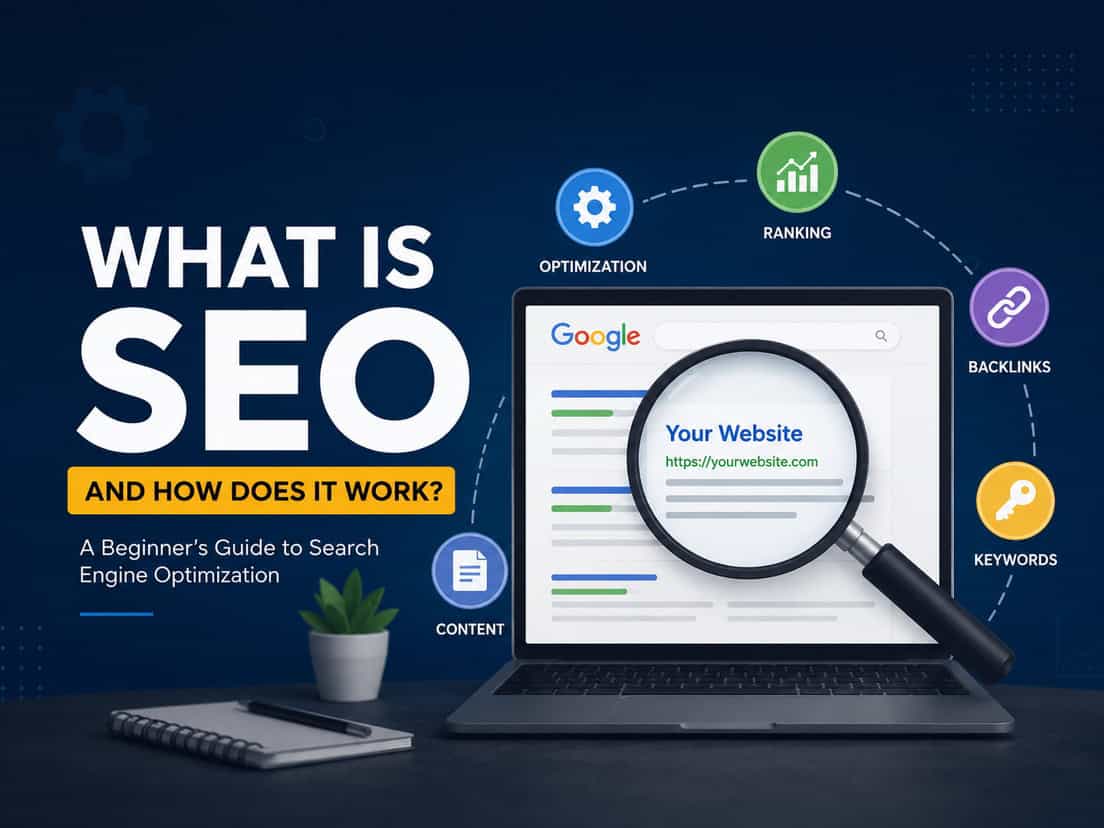
SEO stands for Search Engine Optimization. It is the process of improving a website so that search engines can understand it, trust it, and show it to people who are searching for relevant products, services, information, or answers.
In simple terms, SEO helps your website appear in search results when someone searches for something related to your business.
But SEO is not just about adding keywords to pages. Modern SEO includes your website structure, content quality, technical setup, user experience, authority, local presence, and increasingly how clearly your content can be understood by AI-powered search systems.
This guide explains what SEO is, how it works, what is involved, how long it takes, and when it makes sense to invest in it.
What Does SEO Mean?
SEO stands for Search Engine Optimization.
The goal is to increase the visibility of your website in unpaid, or organic, search results.
For example, someone might search Google for:
- accountant in London
- best massage course online
- how to fix a slow WordPress website
- web designer for small businesses
- dentist near me
- how much does a website cost
- SEO consultant for ecommerce
If your website has a relevant, useful, technically sound page that search engines consider a good answer to that query, it may appear in the search results.
The higher and more frequently your pages appear for relevant searches, the greater the chance that potential customers will discover your business.
Organic Search vs. Paid Search
SEO primarily focuses on organic search results.
Organic results are different from paid advertising such as Google Ads.
With paid search:
- You pay to advertise.
- Your ads can often appear almost immediately.
- You normally pay for clicks, impressions, conversions, or another advertising objective.
- Traffic usually stops when you stop paying for the campaign.
With SEO:
- You improve your website and content over time.
- Results usually take longer to develop.
- You do not pay Google each time someone clicks an organic result.
- Well-performing pages can continue bringing visitors long after they were created.
SEO and paid advertising are not necessarily alternatives. Many businesses use both.
How Does SEO Work?
Search engines use automated systems to discover web pages, understand what they contain, and decide which results are most useful for a particular search.
The process can be simplified into four main stages:
- Crawling – search engines discover pages and follow links.
- Indexing – they process and store information about those pages.
- Understanding relevance – they determine what each page is about and which searches it may answer.
- Ranking – they decide which pages should appear, and in what order, for a particular query.
SEO improves the signals that help search engines during all four stages.
What Do Search Engines Look For?
There is no single SEO factor that determines whether a website ranks well.
Search engines evaluate many signals together. These can include:
- How closely the page matches the searcher’s intent
- The quality and usefulness of the content
- Whether the website can be crawled and indexed properly
- The structure of the page
- Internal linking
- Website speed and usability
- Mobile usability
- The reputation and authority of the website
- Links and mentions from other websites
- Local business signals
- Content freshness where freshness matters
- Whether the page provides a clear and complete answer
This is why SEO usually involves several different types of work rather than one isolated task.
The Main Types of SEO
SEO is often divided into several areas. In practice, they overlap.
1. On-Page SEO
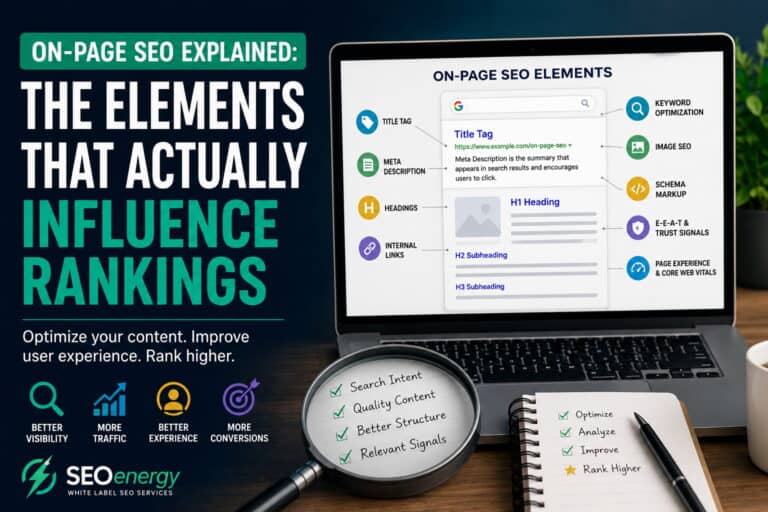
On-page SEO is the optimization of the content and structure of individual pages.
This can include:
- Choosing the right topic and search intent
- Using clear page titles
- Writing useful headings
- Creating relevant page content
- Using important terminology naturally
- Improving internal links
- Optimizing image alt text where appropriate
- Writing effective title tags and meta descriptions
- Using descriptive URLs
- Organizing information in a logical way
Good on-page SEO makes the page easier to understand for both users and search engines.
2. Technical SEO
Technical SEO focuses on whether search engines can efficiently access, crawl, understand, and index the website.
Common technical SEO work includes:
- Fixing indexing problems
- Improving crawlability
- Creating and checking XML sitemaps
- Managing robots directives
- Fixing broken links
- Correcting redirects
- Handling duplicate pages
- Using canonical URLs correctly
- Improving page speed
- Improving mobile usability
- Adding structured data where useful
- Fixing incorrect HTTP status codes
- Improving website architecture
A website can have excellent content and still perform poorly if search engines have difficulty accessing or understanding it.
3. Content SEO
Content SEO is about creating pages that answer the questions potential customers are actually asking.
Depending on the business, useful SEO content may include:
- Service pages
- Product pages
- Category pages
- Blog articles
- Guides
- FAQs
- Case studies
- Comparison pages
- Location pages
- Glossaries
- Tutorials
- Industry resources
The objective is not to publish as many articles as possible. The objective is to create the right pages for the searches that matter to your business.
4. Off-Page SEO
Off-page SEO refers to signals outside your own website that can influence its reputation and authority.
This can include:
- Links from relevant websites
- Industry mentions
- Digital PR
- Business directories
- Professional associations
- Editorial references
- Reviews
- Local citations
- Brand mentions
Backlinks are an important part of SEO, but quality matters far more than simply collecting large numbers of links.
5. Local SEO
Local SEO is especially important for businesses that serve customers in a specific geographical area.
Examples include:
- Dentists
- Restaurants
- Law firms
- Massage therapists
- Home improvement companies
- Accountants
- Hair salons
- Clinics
- Local retailers
- Tradespeople
Local SEO may involve optimizing:
- Google Business Profile
- Business information across directories
- Location pages
- Local keywords
- Customer reviews
- Local links and citations
- Maps visibility
SEO Starts With Search Intent
One of the most important SEO concepts is search intent.
Search intent means understanding what the person is actually trying to accomplish when they type a query.
For example, someone searching for “what is SEO” is probably looking for information.
Someone searching for “SEO consultant for small business” may be looking to hire someone.
Someone searching for “SEO audit price” is probably much closer to making a purchasing decision.
Search intent is often grouped into categories such as:
- Informational – the user wants to learn something.
- Navigational – the user wants to reach a particular website or brand.
- Commercial investigation – the user is comparing solutions.
- Transactional – the user is ready to buy, book, contact, download, or take another action.
A page usually performs better when its purpose matches the intent behind the search.
What Are Keywords?
Keywords are words and phrases associated with what people search for.
Historically, SEO was often described as placing exact keywords throughout a page. Modern SEO is much broader.
Search engines are increasingly capable of understanding:
- Related terms
- Synonyms
- Topics
- Context
- Entities
- Questions
- Natural language
- User intent
This means you normally do not need to repeat the exact same phrase over and over again.
Instead, good SEO content should cover a topic clearly and naturally.
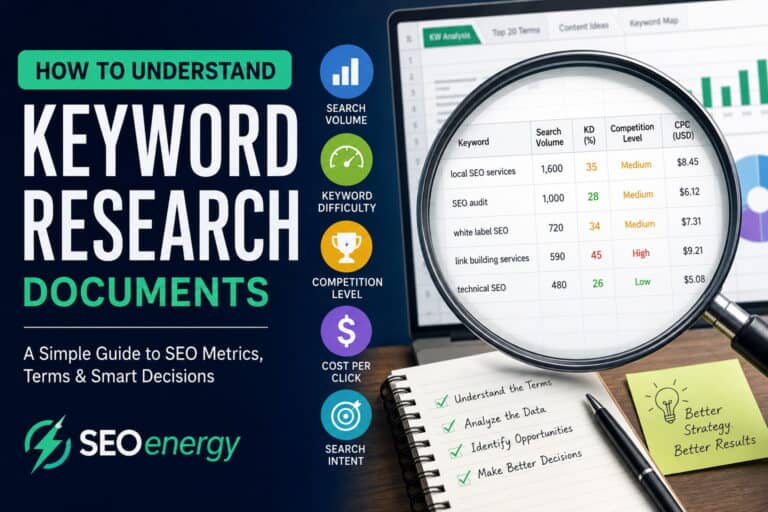
What Is Keyword Research?
Keyword research is the process of identifying the topics and searches that may be relevant to your business.
Useful keyword research looks at more than search volume.
It may consider:
- How relevant the search is to your services
- What the searcher is trying to accomplish
- How competitive the results are
- Whether the query has commercial value
- What kind of page Google currently prefers
- Whether your website realistically has a chance to compete
- How the topic fits into the rest of your site
A keyword with 100 searches per month that regularly brings qualified leads can be much more valuable than a broad keyword with 10,000 searches but little relevance to your business.
Why Website Structure Matters for SEO
SEO is not only about individual pages. The structure of the entire website matters.
A well-organized website helps users and search engines understand:
- What the business offers
- Which pages are most important
- How services relate to each other
- Which articles support which services
- How different topics are connected
For example, a web design company might have:
- A main Web Design page
- A Landing Page Design page
- An E-commerce Website page
- A Website Redesign page
- A blog article explaining how much a website costs
- A guide explaining the website design process
- An article explaining the difference between a landing page and a full website
Internal links between these pages help create a clearer topical structure.
What Are Backlinks?
A backlink is a link from another website to yours.
Search engines can treat relevant, trustworthy links as a signal that other websites consider your content or business worth referencing.
However, backlinks vary enormously in quality.
Useful links might come from:
- Industry websites
- Professional organizations
- Suppliers
- Partners
- News publications
- Relevant blogs
- Local organizations
- Universities
- Business directories
- Resources that genuinely recommend your content
Buying large quantities of low-quality links or participating in manipulative linking schemes can create more problems than benefits.
Does Website Speed Affect SEO?
Website performance is one part of the overall SEO picture.
A faster website can improve the experience for visitors and make it easier for them to browse, read, submit forms, or complete purchases.
Performance problems can be caused by:
- Large images
- Poor hosting
- Excessive plugins
- Heavy JavaScript
- Unoptimized fonts
- Third-party scripts
- Large page builders or themes
- Poor caching configuration
- Database problems
- External tracking and marketing tools
Speed alone will not make a weak page rank well, but severe performance and usability problems can reduce the overall quality of the website.
Does SEO Mean Writing Blog Posts?
Blogging can be part of SEO, but SEO is not the same thing as blogging.
For many businesses, the most important SEO pages are actually commercial pages such as:
- Service pages
- Product pages
- Category pages
- Location pages
- Comparison pages
- Pricing pages
Blog articles are useful when they answer questions related to the customer’s buying journey.
For example, a web design company might publish articles about:
- How much websites cost
- How long it takes to build a website
- What information a client needs to provide
- What website hosting is
- When a website redesign is necessary
- What SEO is
- What conversion tracking is
These articles can attract search traffic, educate potential clients, and support sales conversations at the same time.
What Is an SEO Audit?
An SEO audit is a structured review of a website’s current SEO situation.
Depending on the scope, an audit may examine:
- Indexing
- Website architecture
- Technical problems
- Page titles and headings
- Existing content
- Internal links
- Backlinks
- Competitors
- Keyword opportunities
- Page speed
- Structured data
- Local SEO
- Duplicate content
- Redirects and broken pages
The purpose of an audit should not simply be to produce a long list of technical warnings. A useful audit prioritizes problems and opportunities according to their likely impact.
How Long Does SEO Take?
SEO usually does not produce immediate results.
Some changes can have an effect relatively quickly, while competitive SEO projects may require months of consistent work.
The timeline depends on factors such as:
- The age and history of the website
- How competitive the market is
- The quality of existing content
- The authority of competing websites
- The number of technical problems
- The quality of your website
- The resources available for content creation
- The number of relevant backlinks and mentions
- Whether you are targeting local, national, or international searches
- How ambitious the target keywords are
For this reason, promises such as “rank #1 in 30 days” should be treated with caution.
Can Anyone Guarantee First-Place Rankings?
No SEO provider controls Google’s rankings.
A professional SEO provider can improve your website, identify opportunities, create better content, fix technical problems, and build a stronger search presence.
But nobody can legitimately guarantee a permanent number-one position for a competitive keyword.
Search results can change because of:
- Algorithm updates
- Competitor activity
- New websites and content
- Changes in user behavior
- Changes in the search results layout
- Location and personalization
- New search features
What Does Good SEO Actually Try to Achieve?
The goal of SEO should not simply be to increase traffic.
The more useful objective is to attract relevant visitors who may become customers.
Depending on the business, useful SEO outcomes might include:
- More qualified enquiries
- More phone calls
- More bookings
- More ecommerce sales
- More product discovery
- More visits to physical locations
- More newsletter subscribers
- Greater visibility for important services
- Improved brand recognition
A smaller number of highly relevant visitors may be more valuable than thousands of visitors who have no interest in what you offer.
How Is SEO Success Measured?
SEO performance can be measured in several ways.
Common metrics include:
- Organic search traffic
- Search impressions
- Search clicks
- Keyword visibility
- Enquiries from organic search
- Sales from organic search
- Form submissions
- Phone calls
- Bookings
- Revenue
- Conversion rate
- Visibility for important service pages
Rankings are useful to monitor, but they should rarely be the only measure of success.
If traffic increases by 100% but none of those visitors become customers, the business value may still be very limited.
What Is AEO and How Is It Related to SEO?
AEO stands for Answer Engine Optimization.
As search engines increasingly provide direct answers and integrate AI-generated responses, businesses also need to think about whether their content can be easily understood, summarized, and referenced by these systems.
AEO can involve:
- Answering questions clearly
- Using descriptive headings
- Providing concise definitions
- Structuring information logically
- Using lists and tables where appropriate
- Providing supporting evidence
- Building subject-matter authority
- Creating content around real customer questions
AEO does not replace SEO. In many cases, the same improvements that make a page clearer for traditional search also make it easier for AI-based systems to understand.
Do Small Businesses Need SEO?
Not every business needs the same level of SEO investment.
SEO is particularly useful when potential customers actively search online for your type of product or service.
It may be a good fit if:
- Your customers use Google to find businesses like yours.
- You want a long-term source of website traffic.
- You offer services with clear search demand.
- Your competitors already receive customers through search.
- You serve a particular city or region.
- You sell products online.
- You regularly answer questions that potential customers search for.
- You want your website to support your sales process more effectively.
SEO may be less important if virtually nobody searches for what you offer or if almost all of your business comes through a closed network, direct referrals, tenders, or another channel that does not involve search.
When Should SEO Start?
Ideally, SEO should be considered before a website is built or redesigned.
This allows decisions about the website structure, page hierarchy, URLs, content, and internal links to be made before development is complete.
For a new website, SEO planning may include:
- Keyword and topic research
- Competitor research
- Website architecture
- Service page planning
- URL structure
- Navigation
- Content requirements
- Redirect planning if replacing an existing site
- Analytics and conversion tracking
Adding SEO after the website has already been built is still possible, but sometimes requires restructuring pages that could have been planned correctly from the beginning.
Common SEO Mistakes
Some of the most common SEO problems are surprisingly basic.
- Creating one page that tries to rank for every service
- Writing content only for search engines rather than customers
- Publishing large quantities of low-value AI-generated content
- Targeting keywords that have little commercial relevance
- Ignoring search intent
- Using vague page titles such as “Services”
- Having no internal linking strategy
- Creating duplicate or nearly identical location pages
- Ignoring technical indexing problems
- Deleting old URLs without redirects
- Buying poor-quality backlinks
- Measuring only rankings instead of business results
- Expecting significant SEO results within a few weeks
- Publishing blog articles without linking them to relevant service pages
What SEO Cannot Fix
SEO can bring relevant people to a website, but it cannot compensate for every business problem.
SEO alone cannot fix:
- An uncompetitive product
- Unclear pricing
- Poor customer service
- A confusing offer
- Weak sales copy
- An unusable website
- A checkout process that does not work
- Slow response to enquiries
- A lack of trust signals
This is why SEO often works best as part of a broader website and marketing strategy.
What Does an SEO Service Usually Include?
SEO services vary significantly depending on the provider and the needs of the website.
A project might include some combination of:
- Initial SEO audit
- Keyword research
- Competitor research
- Technical fixes
- Website architecture improvements
- On-page optimization
- Content planning
- Content creation
- Internal linking
- Local SEO
- Google Business Profile optimization
- Link acquisition
- Digital PR
- Analytics setup
- Conversion tracking
- Ongoing reporting
- Regular strategy reviews
This is also why two SEO quotes can be very different even when both are described simply as “SEO.”
Is SEO a One-Time Job?
Some SEO work can be completed as a one-time project.
Examples include:
- A technical SEO audit
- A website migration
- Keyword research
- Website structure planning
- Optimizing an existing set of service pages
- Fixing indexing problems
However, competitive SEO is usually an ongoing process.
Competitors publish new content, search behavior changes, websites evolve, and search engines update their systems.
Ongoing SEO may involve:
- Creating new content
- Updating existing pages
- Monitoring technical issues
- Improving internal links
- Responding to competitor changes
- Developing new service or location pages
- Acquiring relevant links and mentions
- Reviewing performance data
SEO in Simple Terms
SEO can seem complicated because it includes many different disciplines, but the basic idea is relatively straightforward.
A strong SEO strategy tries to make sure that:
- Search engines can access your website.
- They can understand what your pages are about.
- Your pages answer real searches better than competing alternatives.
- Your website demonstrates enough quality and credibility to deserve visibility.
- Visitors can easily understand your offer and take the next step.
Good SEO is not about tricking Google. It is about building a website that clearly answers the questions your potential customers are asking and making it easy for search engines to understand why your pages are useful.
Frequently Asked Questions About SEO
Is SEO free?
You do not normally pay search engines for organic clicks, but SEO itself is not necessarily free. It requires time, research, content, technical work, and often specialist expertise.
Do I need SEO if I already run Google Ads?
Not necessarily, but SEO and paid advertising can complement each other. Ads can provide immediate visibility, while SEO can build a longer-term organic presence.
How often should SEO be done?
It depends on the website and market. Some technical improvements are one-time tasks, while content optimization, competitive research, and performance monitoring are often ongoing.
Can a new website rank on Google?
Yes. New websites can rank, but they often need time to build content, authority, links, and a history of useful performance.
Do I need a blog for SEO?
No. Some websites can perform well primarily through strong service, product, category, or location pages. A blog is useful when there are relevant informational searches that support your business goals.
Is SEO still relevant with AI search?
Yes. Search is evolving, but websites still need clear structure, useful content, strong authority, technical accessibility, and trustworthy information. Many traditional SEO principles also help search and AI systems understand content more effectively.
Final Thoughts
SEO is the process of making your website easier to discover, understand, and trust in search.
It can involve technical improvements, content, keyword research, website structure, local optimization, links, analytics, and ongoing strategy.
The right approach depends on your business, your competitors, your website, and the searches your potential customers actually make.
For some businesses, a few well-optimized service pages and a technically sound website may be enough to create meaningful results. In competitive industries, SEO may require continuous work across multiple areas.
The most important point is that SEO should not be treated as a checklist of tricks. It should connect your website with the people who are actively looking for what you offer.