How Much Does a Website Review Cost?
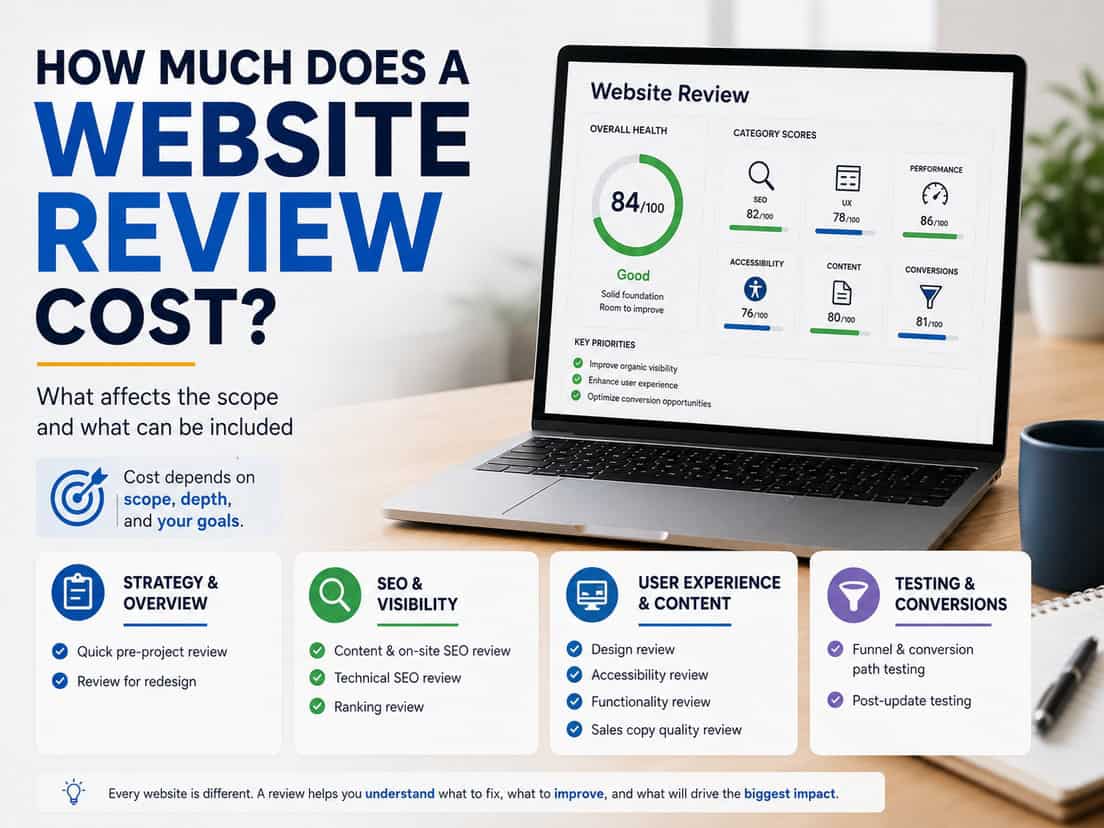
A website review can mean anything from a quick look before a first conversation to a deep, multi-part analysis covering SEO, usability, content, and more. Sometimes it’s a single service, and in other cases it can be a set of them, each aimed at a different purpose, so the answer to the cost is the familiar one: it depends on what you actually need.
The useful way to think about it isn’t by size but by purpose. What are you trying to decide? Whether to redesign, where to improve SEO, why a funnel isn’t converting? Each of those calls for a different review, looking at different things. Here are the main ones:
- Quick pre-discovery review (free, before the discovery call)
- Review for redesign (page-by-page complexity)
- Content & on-site SEO review (pages, SEO data, content gaps)
- Technical SEO review (technical snapshot)
- Ranking review (do the right pages rank)
- Design review (design, contrast, readability, clarity)
- Accessibility review (full a11y check)
- Functionality review (how features work)
- Sales copy quality review (how well the copy sells)
- Funnel & conversion path testing (the whole journey)
- Post-update testing (nothing broke)
Two things run through almost all of them. Most can be delivered as just the report (the raw data or findings) or, for more, as a report with interpretation, where the findings are written up with priorities and recommendations. And most are one-off jobs that scale with the size of the site. The exception is the first one, which is free.
Quick pre-discovery review
A quick pre-discovery review is a fast, informal look I take at a site before the discovery call with a new client, so I come to that conversation already understanding what I’m dealing with and where the obvious opportunities or problems are.
What it looks at
- overall state, first impressions, and obvious issues
- a rough sense of size, complexity, and quality
- whether the project is a good fit to work on together
What you get
A short, informal summary in conversation rather than a formal document. It’s the starting point for a useful first discussion, not a deliverable in itself.
How common it is
Standard on my side before every discovery call. It’s how I come to that conversation already understanding the site.
Price
Free. It’s part of how I start working with someone, not a paid service.
Review for redesign
A review for redesign is a page-by-page inventory of a site, with an assessment of how complex each page is to design and build, used to scope and quote a redesign accurately.
What it looks at
- a full list of every page on the site
- design complexity of each page
- functionality and special elements per page
What you get
A structured list of all pages with a complexity rating for each, giving a clear, realistic basis for scoping and quoting a redesign rather than guessing.
Report options
Available as the report on its own (the data, list, or findings), or as report plus interpretation, where the key findings are written up with priorities and recommendations. The interpretation is the added-value part and is priced on top of the raw report.
How common it is
Common before any redesign quote, and useful whether the site is the client’s own or a competitor’s used as a reference for what to build.
Client input
The client points to the site and the goal. For their own site, they can flag pages that must stay or go.
Price impact
The inventory scales with the number of pages. A small site is quick; a large one with many unique page types takes longer to assess properly.
Price range
Roughly EUR 100 to 600 as a one-off, depending on site size; interpretation adds to that. Most projects land in this range, but the final figure is set case by case, since too many inputs feed into it to fix one price.
Content & on-site SEO review
A content and on-site SEO review combines a page-level inventory of on-page SEO data with an assessment of where content is thin, so you can plan both optimization and new content from one document.
What it looks at
- per-page SEO data (title, meta, word count, headings)
- where content is thin and should be expanded
- content gaps for new pages, plus a page and section list usable for internal linking
What you get
A per-page table of on-site SEO data alongside content notes, doubling as a map for planning on-page optimization, new content, and internal linking.
Report options
Available as the report on its own (the data, list, or findings), or as report plus interpretation, where the key findings are written up with priorities and recommendations. The interpretation is the added-value part and is priced on top of the raw report.
How common it is
Common for anyone planning on-site SEO or a content push. The same page inventory is also the basis for a solid internal linking plan.
Client input
The client’s target terms and priorities sharpen the content-gap side, since thin is relative to what the page is trying to rank for.
Price impact
Scales with page count. Pulling the raw data is fairly quick; the content-gap assessment is where the time goes.
Price range
Roughly EUR 120 to 700 as a one-off, depending on site size; interpretation adds to that. Most projects land in this range, but the final figure is set case by case, since too many inputs feed into it to fix one price.
Technical SEO review
A technical SEO review is a snapshot of the technical factors that affect search: speed, indexing, crawlability, and errors. It’s kept separate because clients often want just this, without the content side.
What it looks at
- indexing, crawlability, and site structure
- speed and core web vitals
- technical errors, redirects, and broken elements
What you get
A snapshot of technical issues affecting search, as a findings list. It’s a diagnostic snapshot for planning, not the same as an ongoing SEO engagement.
Report options
Available as the report on its own (the data, list, or findings), or as report plus interpretation, where the key findings are written up with priorities and recommendations. The interpretation is the added-value part and is priced on top of the raw report.
How common it is
Often requested on its own, since technical and on-site SEO are separate concerns and clients frequently need only one of the two.
Price impact
A small, healthy site is quick to check. A large or neglected one surfaces more to document and explain.
Price range
Roughly EUR 100 to 600 as a one-off; interpretation adds to that. Most projects land in this range, but the final figure is set case by case, since too many inputs feed into it to fix one price.
Ranking review
A ranking review checks whether the page you actually chose to rank for a given keyword is the one that ranks, and where, or whether a different page is ranking instead.
What it looks at
- which page ranks for each target keyword, and at what position
- whether the intended page or a different one is ranking
- keyword cannibalization, where several pages compete for the same term
What you get
A table matching target keywords to the pages that actually rank and their positions, flagging mismatches and cannibalization to fix.
Report options
Available as the report on its own (the data, list, or findings), or as report plus interpretation, where the key findings are written up with priorities and recommendations. The interpretation is the added-value part and is priced on top of the raw report.
How common it is
Useful for anyone with existing SEO effort who suspects it isn’t landing where intended. A common hidden cause of underperformance.
Client input
The client’s list of target keywords and their intended page for each is the starting point; without it, the review is guessing at intent.
Price impact
Scales with how many keywords and pages are checked. A focused set is quick; a large keyword map takes longer.
Price range
Roughly EUR 80 to 500 as a one-off, depending on how many terms; interpretation adds to that. Most projects land in this range, but the final figure is set case by case, since too many inputs feed into it to fix one price.
Design review
A design review assesses the visual fundamentals: contrast, readability, clarity, colour harmony, and how consistent the design elements are, with practical recommendations. It covers core design quality, not full accessibility testing.
What it looks at
- contrast, readability, and legibility
- colour harmony, visual clarity, hierarchy, and layout
- consistency of design elements (borders, radius, padding, spacing)
What you get
A set of design findings and practical recommendations, covering both how the site reads (contrast, readability, clarity) and how consistent and harmonious its visual elements are.
Report options
Available as the report on its own (the data, list, or findings), or as report plus interpretation, where the key findings are written up with priorities and recommendations. The interpretation is the added-value part and is priced on top of the raw report.
How common it is
Useful for sites that feel off but where the owner can’t say why. Often the fastest way to a noticeably better-looking site without a full redesign.
Price impact
A quick pass on a few templates is fast. A thorough review across many unique page types takes longer.
Price range
Roughly EUR 80 to 450 as a one-off; interpretation adds to that. Most projects land in this range, but the final figure is set case by case, since too many inputs feed into it to fix one price.
Accessibility review
An accessibility review is a fuller check of how usable the site is for people with disabilities, against recognized accessibility standards, going well beyond the design basics.
What it looks at
- compliance with accessibility standards (such as WCAG)
- keyboard navigation, screen-reader support, and focus states
- contrast, alt text, forms, and structure for assistive tech
What you get
An accessibility findings report against recognized standards, showing where the site falls short and what to fix.
Report options
Available as the report on its own (the data, list, or findings), or as report plus interpretation, where the key findings are written up with priorities and recommendations. The interpretation is the added-value part and is priced on top of the raw report.
How common it is
Increasingly requested, and in some sectors and regions a legal requirement. More involved than a design review and treated as its own thing.
Price impact
This is more thorough than a design pass, since it tests against defined standards. Larger, more interactive sites take considerably more checking.
Price range
Roughly EUR 200 to 1,200 as a one-off, depending on site size and depth; interpretation adds to that. Most projects land in this range, but the final figure is set case by case, since too many inputs feed into it to fix one price.
Functionality review
A functionality review examines how a site’s features actually work: an existing site I didn’t build, or a competitor’s site to understand what it offers and how.
What it looks at
- what features and functionality exist
- how well each works and where it falls short
- how a competitor’s site is built and behaves
What you get
A rundown of the site’s functionality, how it performs, and notes on anything worth replicating, fixing, or improving.
Report options
Available as the report on its own (the data, list, or findings), or as report plus interpretation, where the key findings are written up with priorities and recommendations. The interpretation is the added-value part and is priced on top of the raw report.
How common it is
Useful for taking over a site built by someone else, or for studying what a competitor offers before matching or beating it.
Client input
Access to the site, and any specific features or competitors of interest, focuses the review.
Price impact
A simple site is quick to work through. A feature-rich one, or a detailed competitor breakdown, takes more time.
Price range
Roughly EUR 100 to 700 as a one-off; interpretation adds to that. Most projects land in this range, but the final figure is set case by case, since too many inputs feed into it to fix one price.
Sales copy quality review
A sales copy quality review assesses how well the site’s persuasive writing actually does its job: how convincing it is, where it loses the reader, and how effectively it drives action.
What it looks at
- how clearly the offer and value come across
- where the copy loses attention or fails to persuade
- how well it guides the reader toward action
What you get
An assessment of the sales copy with specific weak points identified, and where relevant, suggested directions for improvement.
Report options
Available as the report on its own (the data, list, or findings), or as report plus interpretation, where the key findings are written up with priorities and recommendations. The interpretation is the added-value part and is priced on top of the raw report.
How common it is
Useful for sites that get traffic but don’t convert, where the writing rather than the design or offer may be the weak link.
Client input
Knowing the target audience and the offer makes the assessment sharper, since copy is judged against who it’s meant to persuade.
Price impact
A single page is quick. Reviewing copy across a full site or funnel takes more time and thought.
Price range
Roughly EUR 80 to 500 as a one-off, depending on how many pages; interpretation adds to that. Most projects land in this range, but the final figure is set case by case, since too many inputs feed into it to fix one price.
Funnel & conversion path testing
Funnel and conversion path testing follows the whole journey a visitor takes toward a sale or signup, checking that every step works and that each page’s message follows on from the last.
What it looks at
- that each step works: forms, checkout, signups, and page flow
- how well each page’s message continues from the previous one
- where people are likely dropping out of the path
What you get
A walkthrough of the conversion path with broken or weak points identified, covering both whether it works technically and whether it holds together as a journey.
Report options
Available as the report on its own (the data, list, or findings), or as report plus interpretation, where the key findings are written up with priorities and recommendations. The interpretation is the added-value part and is priced on top of the raw report.
How common it is
Useful for any site built to sell or capture leads, especially when traffic arrives but conversions don’t follow.
Client input
Knowing the intended path and goal is essential, since testing a funnel means testing it against what it’s supposed to achieve.
Price impact
A short path with a couple of steps is quick. A full e-commerce or multi-step funnel, checked end to end, takes considerably more.
Price range
Roughly EUR 120 to 800 as a one-off, depending on funnel length and complexity; interpretation adds to that. Most projects land in this range, but the final figure is set case by case, since too many inputs feed into it to fix one price.
Post-update testing
Post-update testing is checking that a site still works correctly after updates have been applied: features, forms, layout, and anything an update might have broken.
What it looks at
- that key features and forms still work
- layout and display across devices
- anything an update may have changed or broken
What you get
Confirmation that the site is working, or a list of what an update broke so it can be fixed. Related to maintenance, but available as a standalone check.
Report options
Available as the report on its own (the data, list, or findings), or as report plus interpretation, where the key findings are written up with priorities and recommendations. The interpretation is the added-value part and is priced on top of the raw report.
How common it is
Useful after major updates, or as a one-off for anyone not on a maintenance plan that already includes it.
Price impact
A small site is quick to verify. A large or feature-heavy one has more to test after each update.
Price range
Roughly EUR 50 to 300 as a one-off; often already included in a maintenance plan. Most projects land in this range, but the final figure is set case by case, since too many inputs feed into it to fix one price.
So what does a website review cost?
Because a review is defined by its purpose, there’s no single price, but a few patterns hold. Most reviews are one-off jobs that scale with the size of the site and the number of pages, keywords, or steps involved. Most come in two forms: the report on its own, or the report plus written interpretation, which costs more because the thinking is the valuable part. And the first quick look, before we ever work together, is free.
If you’re not sure which review you need, that’s normal, and it’s usually clearer after a short conversation about what you’re trying to decide. Often a single review answers the question; sometimes a couple of them together give the full picture.