How Much Does a Website Cost?
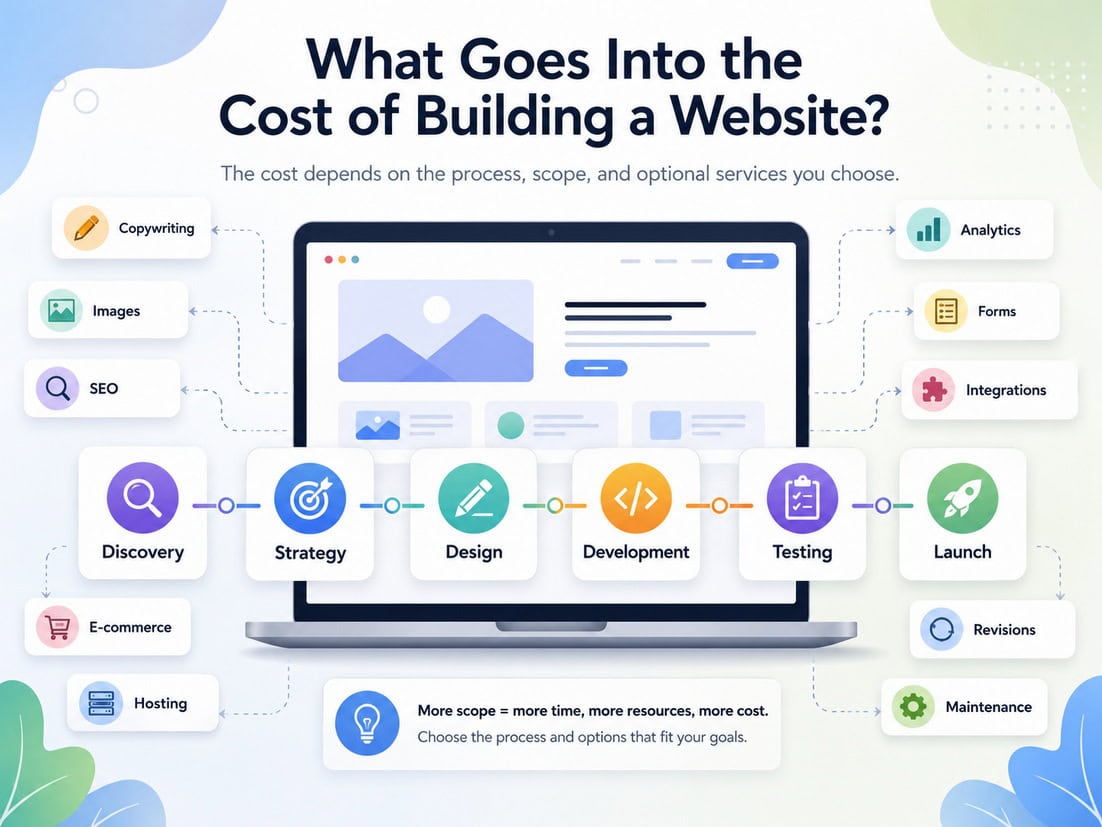
The shortest honest answer: it depends. Not as an excuse, but because a “website” isn’t one thing, it’s a set of decisions. Two sites with the same page count can differ several times over in price, depending on what actually goes into them.
So let’s first walk through everything that affects the price, split into four groups:
- Site content (informational content, sales copy, blog posts, images, video, downloadable resources)
- Visual identity (branding, design)
- Technical work (development, number of pages, revisions)
- Strategy and optimization (strategy, conversion tracking)
Each item also notes how common it actually is, because not everyone needs everything. I’ve saved the concrete price ranges by site type for the very end, once it’s clear what’s hiding behind those numbers.
Site content
Site content is the reason people actually come to a site, and what makes them stay or leave. Design catches attention, but content does the work. This is also the group where the gap between what a client sends and what’s actually needed shows up most often. It splits into several types, and each carries its own kind of work.
Informational content
Informational content is the text of pages meant to inform rather than sell: about, service descriptions, FAQs, terms and policies.
Scope and price depend on
- number of pages and their length
- whether it’s written from scratch or edited from existing material
- how technical the topic is and whether it needs research
How common it is
Essential. Every site has at least a few pages like this, whatever its purpose.
Client input
Clients usually send something already written, or at least notes. That speeds things up, but it’s rarely ready as-is, and not only because of language. Even text that reads fine as information often has to be reshaped for the web, where people skim and scroll before they commit to reading. The work is to cut it down and organize it so the most important points stand out at a glance: what the company does, why it’s credible, who it’s for, and what to do next. Fixing the English is the easy part; structuring it for how people actually read online is where most of the effort goes.
Price impact
What costs time is how much the raw material has to be reshaped, not how many words it has. A clean page that mainly needs restructuring and trimming is quick. A page that has to be researched and written from scratch for a technical field takes far longer, even if the finished text ends up shorter than what you started with.
Price range
Roughly EUR 120 to 600 depending on how many pages and how much reshaping the material needs. Most projects land in this range, but the final figure is set case by case, since too many inputs feed into it to fix one price.
Sales copy
Sales copy is text written to persuade rather than inform: it guides a visitor toward a clear action, whether a purchase, a sign-up, or a booking.
Scope and price depend on
- number of pages that need to “sell” (homepage, service/product pages, landing pages)
- depth of audience and competitor research
- number of revisions and whether variants are tested
How common it is
Practically essential for the homepage and service/product pages. Anyone expecting the site to actually sell, not just exist online, has this.
Client input
This is where expectations and reality drift apart most. Good sales copy isn’t something you get from a single briefing. It normally runs through an initial call to understand the offer, the audience, and their objections, then several rounds of drafting and refinement, and a final call before it’s signed off. The work usually follows an established copywriting framework rather than guesswork, and each page is reworked until it does its job. Sending existing text or a rough outline helps, but it’s a starting point, not a shortcut past that process.
Price impact
What you’re paying for is the process, not the length of the page. A single well-built sales page has research, a proven structure, and several revision rounds behind it, which is why it costs several times more than an informational page of the same size.
Price range
Roughly EUR 250 to 1,200 per sales-focused page, depending on research and revision rounds. Most projects land in this range, but the final figure is set case by case, since too many inputs feed into it to fix one price.
Blog posts
Blog posts are articles that attract visitors through search, build trust, and demonstrate expertise over time.
Scope and price depend on
- number of posts and their length
- whether keyword research is done
- how demanding the topic is and whether it needs expert review
How common it is
Optional. Worth it for those planning to build search traffic or publish regularly. For a simple presentation site, it’s often skipped at the start.
Client input
If the client has topics and rough material, the work is faster. If they expect both topics and text to be created from scratch, that’s a separate, larger part of the project.
Price impact
A few posts now and then is one thing. Regular production with keyword research is a separate, ongoing cost.
Price range
Roughly EUR 60 to 250 per post, depending on length, research, and topic difficulty. Most projects land in this range, but the final figure is set case by case, since too many inputs feed into it to fix one price.
Images
Images are the photos, illustrations, icons, and graphics that support the text and shape the impression.
This usually includes
- selecting and editing existing photos
- sourcing and preparing stock material
- creating simple graphics and icons
How common it is
Essential in some form, since a site without a single image feels unfinished. The scope varies dramatically.
Client input
This is where the gap is largest. Clients often send phone photos, a low-resolution logo, or random material. Fine as a starting point, but it almost always needs editing, cropping, and consistency work, and sometimes replacing with stock photos to make everything look professional.
Price impact
When the client has quality, usable material, it goes fast. When images have to be sourced, bought, and edited from scratch, the time grows with every page.
Price range
Often folded into design; when handled separately, roughly EUR 100 to 500 for a typical site. Most projects land in this range, but the final figure is set case by case, since too many inputs feed into it to fix one price.
Video
Video covers any moving content on the site: recorded footage, simple animations, or background clips.
Scope and price depend on
- whether footage already exists or has to be produced
- amount of editing, captioning, and compression
- whether it’s hosted directly or embedded from another platform
How common it is
Optional, and less common than images. Worth it when a product or service is easier to show than to describe.
Client input
Clients sometimes have raw footage that needs trimming and cleanup. Full production from nothing is a separate project with its own budget, usually beyond the website itself.
Price impact
Embedding an existing clip is quick. Editing raw footage, or producing video from scratch, is one of the more time-consuming things you can add.
Price range
From roughly EUR 80 to embed and tidy existing clips, up to EUR 1,000+ for edited or produced video. Most projects land in this range, but the final figure is set case by case, since too many inputs feed into it to fix one price.
Downloadable & embedded resources
Downloadable and embedded resources are the extra pieces that live on or within a page: PDFs, lead magnets, forms, calculators, or embedded maps.
This can include
- preparing and styling downloadable files (price lists, catalogs, guides)
- building and connecting forms or lead-capture elements
- embedding third-party tools (booking, calculators, maps)
How common it is
Depends on the goal. A lead magnet or booking form is common for anyone collecting leads; for a simple brochure site, often none of this is needed.
Client input
Clients may send a document to be turned into a clean, on-brand PDF, or ask for a form without knowing exactly what it should collect. A short conversation usually clears up what’s actually required. Plain links to external sites, by contrast, add no real cost.
Price impact
A single styled PDF or a basic contact form is minor. A multi-step form, a lead-capture flow, or an embedded custom tool takes real setup and testing.
Price range
Roughly EUR 50 to 600 depending on how many resources and how much custom setup. Most projects land in this range, but the final figure is set case by case, since too many inputs feed into it to fix one price.
Visual identity
Visual identity is how the site looks and feels, and how consistent that impression stays from page to page. It’s the difference between a site that looks put together and one that looks improvised, and it shapes trust before a single line of text is read.
Branding & brand assets
Branding covers the core visual elements the site is built on: logo, colors, fonts, and the general style that ties everything together.
This can include
- logo use, or basic logo cleanup and versions
- defining colors and fonts for the site
- simple brand elements like buttons, icons, and section styles
How common it is
Depends on where the client starts. Anyone with an existing brand just needs it applied; anyone without one needs at least the basics defined before design can begin.
Client input
Clients often have a logo and some idea of colors, but rarely a full set of usable brand files. Part of the work is turning what exists into something consistent that can actually be used across the site.
Price impact
Applying an existing, well-defined brand is quick. Building the basics from nothing, or fixing an inconsistent one, adds design time before the site itself starts.
Price range
Roughly EUR 150 to 800 for applying or lightly shaping an existing brand. Most projects land in this range, but the final figure is set case by case, since too many inputs feed into it to fix one price.
Web design
Web design is the visual layout of the pages: how sections are arranged, how content is presented, and how the site guides the eye.
Scope and price depend on
- number of unique page layouts (not just pages)
- how custom the design is versus template-based
- attention to detail on spacing, imagery, and states
How common it is
Essential. Every site is designed somehow; the only question is how custom and how carefully.
Client input
Clients sometimes share sites they like or a rough idea of the feel they want. That’s useful direction, but turning references into a coherent design for their own content is the actual work.
Price impact
A clean, template-based layout is faster and cheaper. A custom design with several unique page types and careful detailing is one of the larger parts of a project.
Price range
Roughly EUR 500 to 3,000 depending on how custom the design is and how many unique layouts are needed. Most projects land in this range, but the final figure is set case by case, since too many inputs feed into it to fix one price.
Design consistency
Design consistency is what keeps every page, section, and element looking like part of the same site as it grows.
This usually involves
- reusable styles for headings, buttons, and sections
- consistent spacing and layout rules across pages
- making sure new pages match without redesign
How common it is
More relevant on larger sites, or ones the client plans to expand. A small brochure site needs little of this; a growing site needs it to avoid looking patched together.
Price impact
On a small site it’s minor and mostly built in. On a larger or growing site, setting up reusable rules upfront costs a bit more early but saves far more later.
Price range
Usually folded into design rather than billed separately; on larger sites, add roughly EUR 200 to 800. Most projects land in this range, but the final figure is set case by case, since too many inputs feed into it to fix one price.
Technical work
Technical work is the actual build: turning design and content into a working site, with however many pages and features it needs. This is often the least visible part to the client and the easiest to underestimate, because a lot of the effort goes into things that only show when they’re missing.
Development & build
Development is assembling the site so it works: building the pages, making them responsive, and getting them running properly on real devices.
Scope and price depend on
- how faithfully the design has to be reproduced
- responsiveness across phones, tablets, and desktops
- speed, accessibility, and browser testing
How common it is
Essential. Nothing goes live without it.
Price impact
A straightforward build on a solid template is efficient. Pixel-faithful custom work, heavy responsiveness, and performance tuning all add time.
Price range
Roughly EUR 400 to 2,500 for the build itself, separate from design and content. Most projects land in this range, but the final figure is set case by case, since too many inputs feed into it to fix one price.
Number of pages
Number of pages is simply how much site there is to build, and it scales almost everything else with it.
What counts here
- total number of unique pages
- how many are truly unique versus repeated templates
- one-off pages that need their own layout
How common it is
Always relevant, since it’s one of the first things that sets the size of a project.
Client input
Clients often underestimate this, counting only the main pages and forgetting legal pages, thank-you pages, and variations. Agreeing the real page count early avoids surprises later.
Price impact
Ten pages built from three repeatable templates is very different from ten pages that are each unique. Unique pages, not raw page count, drive the cost.
Price range
As a rough guide, EUR 50 to 250 per additional page, less when it reuses an existing template. Most projects land in this range, but the final figure is set case by case, since too many inputs feed into it to fix one price.
Functionality & integrations
Functionality is everything the site does beyond displaying pages: forms, bookings, payments, memberships, or connections to outside tools.
This can include
- contact, booking, or multi-step forms
- online store, checkout, and payments
- connecting email, CRM, scheduling, or other tools
How common it is
Depends entirely on the goal. A brochure site may need almost none; a store or booking site is mostly this.
Client input
Clients often describe what they want the site to do without knowing what that takes technically. A short conversation to pin down exactly how each feature should work usually comes before any of it is built.
Price impact
A basic contact form is minor. A store, a booking system, or several connected tools each add real build and testing time, and are often the biggest single cost on a project.
Price range
Anywhere from near zero for a simple form to EUR 500 to 3,000+ for a store or booking system. Most projects land in this range, but the final figure is set case by case, since too many inputs feed into it to fix one price.
Revisions
Revisions are the rounds of changes and adjustments made after something is first delivered, until it’s right.
What affects them
- how many revision rounds are included
- how large the changes are (wording versus rebuilds)
- how clear the brief and feedback are
How common it is
Always part of a project. The question is how many rounds are included before extra ones are billed.
Client input
Clear, consolidated feedback keeps revisions efficient. Scattered or contradictory changes across many rounds are where scope, and cost, tend to creep.
Price impact
A couple of focused rounds are normally built into the price. Open-ended changes, or reworking things already agreed, are what push a project over budget.
Price range
Usually included within a set number of rounds; extra rounds roughly EUR 30 to 80 per hour of changes. Most projects land in this range, but the final figure is set case by case, since too many inputs feed into it to fix one price.
Strategy and optimization
Strategy and optimization is the part that decides whether the site actually works, not just whether it exists. It’s the easiest group to skip and the one that most often separates a site that quietly earns its keep from one that just sits there.
Strategy & planning
Strategy is the thinking done before design and build: what the site is for, who it speaks to, and how its structure should serve that.
This can include
- clarifying the main goal and target audience
- planning site structure and page flow
- deciding what each page should achieve
How common it is
Recommended for anyone who wants the site to perform, not just look good. Small, simple sites can get by with a light version; anything with real goals benefits from it.
Client input
Clients usually come with a rough idea rather than a defined plan. Shaping that into a clear structure and purpose is the work here, and it makes everything after it faster.
Price impact
A light planning pass on a small site is quick. Deeper strategy for a site meant to generate leads or sales takes more upfront time, but reduces expensive changes later.
Price range
Roughly EUR 150 to 1,000 depending on how much is already decided going in. Most projects land in this range, but the final figure is set case by case, since too many inputs feed into it to fix one price.
SEO setup
SEO setup is the groundwork that helps a site be found in search: technical basics, sensible structure, and correctly handled content.
This usually covers
- titles, meta descriptions, and clean URLs
- headings, structure, and basic on-page SEO
- speed, mobile, and indexing essentials
How common it is
Recommended in its basic form for almost any site. Ongoing SEO work is a separate, larger commitment for those competing in search.
Price impact
Basic setup done during the build is modest and worth it. Ongoing optimization, content, and link work is a continuous service, priced separately.
Price range
Basic setup roughly EUR 100 to 600; ongoing SEO is a separate monthly arrangement. Most projects land in this range, but the final figure is set case by case, since too many inputs feed into it to fix one price.
Conversion tracking
Conversion tracking is the setup that measures whether visitors do what the site wants: buy, book, sign up, or get in touch.
This can involve
- defining the specific actions worth tracking
- setting up analytics and event tracking
- connecting pixels for ad platforms
How common it is
Depends heavily on how the site is used. Close to essential when running Google or Meta ads, since without it there’s no way to tell what the spend is doing. Often skipped on a site that runs no paid campaigns.
Client input
This is one thing clients rarely understand upfront. It usually needs the client or their marketer to say what actually counts as a result, which is agreed together before anything is set up.
Price impact
A few clearly defined goals are a quick setup. Tracking a full funnel across several steps and tools takes considerably more time.
Price range
Roughly EUR 100 to 700 depending on how many actions and platforms are tracked. Most projects land in this range, but the final figure is set case by case, since too many inputs feed into it to fix one price.
Analytics & maintenance
Maintenance is keeping the site healthy after launch: updates, backups, security, and small ongoing changes.
This can include
- updates, backups, and security checks
- fixing issues and small content changes
- periodic reporting on how the site performs
How common it is
Recommended for any site meant to run reliably over time. Optional at launch, but the cost of neglect usually shows up eventually.
Price impact
Occasional ad-hoc fixes are billed as they come. A monthly plan costs more predictably but keeps the site current and avoids larger repair bills down the line.
Price range
Typically EUR 30 to 150 per month for a maintenance plan, or hourly for occasional work. Most projects land in this range, but the final figure is set case by case, since too many inputs feed into it to fix one price.
So what does it actually cost?
With all of that in view, the ranges below make more sense. They’re rough starting points by site type, based on typical projects. They’re not a menu: two sites of the same type can sit at opposite ends of a range depending on how many of the things above are involved, how much is built from scratch, and how much the client already has ready.
They also reflect a floor. Below a certain point, a site can’t be done properly, so even the simplest project starts around the lower end rather than below it.
Landing page
A single focused page built to do one job, usually capture leads or sell one thing. Small in size but often heavy on copy and conversion work. Roughly EUR 600 to 2,000. Most projects land in this range, but the final figure is set case by case, since too many inputs feed into it to fix one price.
Presentation site
A standard multi-page site presenting a business, its services, and how to get in touch. The most common type, and the widest range, since page count and custom design vary a lot. Roughly EUR 1,200 to 5,000. Most projects land in this range, but the final figure is set case by case, since too many inputs feed into it to fix one price.
Online store
A site built to sell products directly, with catalog, checkout, payments, and the extra functionality that comes with them. The most involved type, and the hardest to pin down without specifics. Roughly EUR 2,500 to 10,000+. Most projects land in this range, but the final figure is set case by case, since too many inputs feed into it to fix one price.
If you’re trying to place your own project in these ranges, the honest next step is a short conversation. Once it’s clear what you already have, what needs building from scratch, and what the site actually has to achieve, the number stops being a range and becomes an actual quote.